
Ancient jokes are a treasure trove of laughs! Puns and wordplay have been around for ages. You’d be surprised how timeless humor can be!
Just the other day, I stumbled upon some old Greek jokes. They cracked me up! Who knew the ancients had such a sense of humor?
Did you know that the oldest recorded joke is over 4,000 years old? It’s from ancient Sumer! Talk about a classic!
Sharing these jokes feels like a fun time travel. I love how humor connects us all. Let’s explore these ancient giggles together! 😂✨
Hilarious Ancient Jokes That Time Forgot (2026 Anthology)
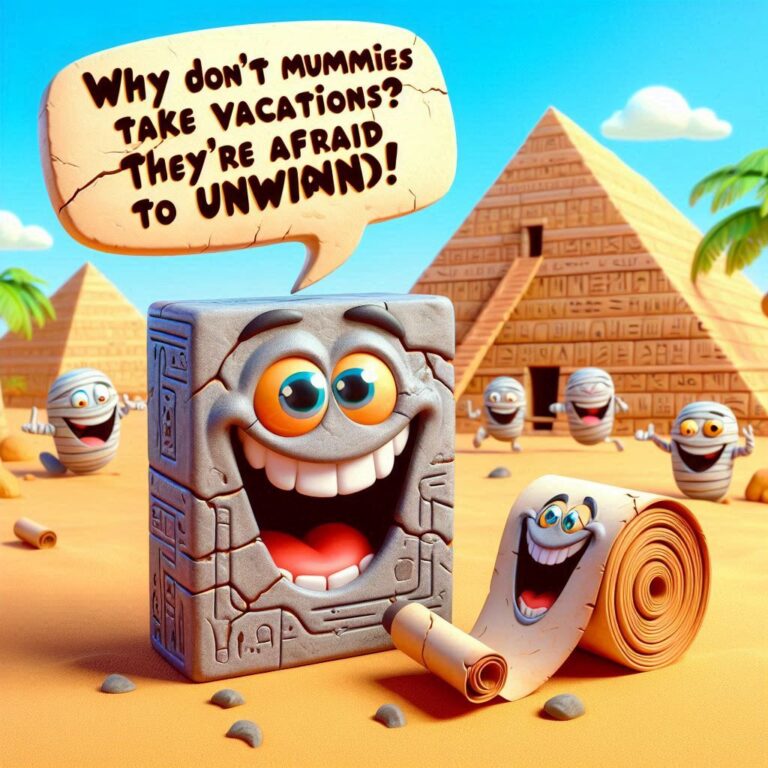
- Why did the Pharaoh go to school? To improve his “mummy-fication”! 🏺😄
- What do you call a Roman with a map? Lost-us Maximus! 🏛️🤣
- How did the caveman fix his cave? With stone-age glue! 🪨😆
- Why did the Trojan horse get a promotion? It knew how to enter the office secretly! 🐴😜
- What’s an ancient Egyptian’s favorite game? Pyramid scheme! 🔺🤣
- How did the mummy know it was sick? He felt a little wrapped up! 🩹😄
- Why did the gladiator go to art class? To learn how to draw his sword! ⚔️😂
- How do ancient philosophers greet each other? “Plato, my friend!” 🏛️😆
- Why don’t skeletons fight each other? They don’t have the guts! 💀😜
- What did the Roman say when he bought shoes? “Alea iacta soles!” 👟🤣
- Why did the Sphinx go to therapy? Too many riddles in its life! 🐱👤😄
1. Ancient Jokes That Will Have You Chortling Like a Pharaoh
Ancient jokes reveal how humor has endured through millennia, offering a glimpse into the playful side of early civilizations. These timeless quips still make us smile today.
- Pharaoh: “Why did I build the pyramids?”
Servant: “To make sure your jokes are always on top.”
Pharaoh: “Good one, but I prefer my humor to be a bit more monumental.” - Priest: “Why did the Sphinx refuse to tell a secret?”
Farmer: “Because it didn’t want to crack up?”
Priest: “Exactly, some mysteries are better left carved in stone.” - Ancient merchant: “I have a joke about my goods.”
Customer: “Tell me, I’m all ears.”
Merchant: “Well, it’s a load of old sand.” - Worker: “My boss says he’s a king.”
Friend: “What do you say?”
Worker: “I tell him he’s just a pyramid scheme.” - Egyptian: “What’s the best way to get to the Nile?”
Tourist: “I don’t know.”
Egyptian: “Just follow the current jokes.” - Pharaoh: “Why do I always win at chess?”
Advisor: “Because you’re a master of pyramids and pawns?”
Pharaoh: “No, because I always have a few tricks up my sleeve.” - Scribe: “Why did the hieroglyphs go to school?”
Student: “To get a little more ink-formation?”
Scribe: “Exactly, education is the key to timeless humor.” - Architect: “Why do pyramids never get old?”
Worker: “Because they’re built to last forever?”
Architect: “And their jokes are carved in stone.” - Priest: “Why did the ancient Egyptians love riddles?”
Scribe: “Because they liked to keep things sealed?”
Priest: “Exactly, some mysteries are best preserved in humor.” - Trader: “What’s the oldest joke in Egypt?”
Customer: “I don’t know.”
Trader: “It’s about a camel that’s always carrying a load of laughs.” - Pharaoh: “Why was the Nile so funny?”
Servant: “Because it always flows with jokes?”
Pharaoh: “No, because it’s full of current humor.” - Jeweler: “Why do ancient treasures have good humor?”
Tourist: “Because they’re priceless?”
Jeweler: “And they sparkle with timeless wit.” - High priest: “Why did the gods laugh at humans?”
Priest: “Because they thought humans were divine comedians?”
High priest: “Exactly, humor was sacred back then.” - Servant: “Why did the pharaoh laugh at his own joke?”
Visitor: “Because he was the ruler of humor?”
Servant: “And his jokes were always pyramid-ly funny.” - Historian: “What’s the oldest joke ever found?”
Archaeologist: “A joke about a guy who lost his sand timer?”
Historian: “No, it’s about a fish that couldn’t find its scale.” - Chamberlain: “Why did the ancient scribe write jokes?”
King: “To keep his scrolls from being too serious?”
Chamberlain: “Exactly, humor was part of the royal script.” - Priest: “What’s the secret to ancient humor?”
Acolyte: “A good laugh carved in stone?”
Priest: “And a little divine timing.” - Farmer: “Why did the Egyptian farmer tell jokes?”
Neighbor: “To make his crops grow faster?”
Farmer: “No, because laughter is the best fertilizer.” - Pharaoh: “What’s the funniest thing about pyramids?”
Servant: “They’re always on top of the humor hierarchy?”
Pharaoh: “Exactly, humor is eternal, just like my tomb.”
These jokes offer a playful peek into ancient humor, showing that laughter truly is a timeless treasure. 😄 We rate the ‘Giggle Factor’ a 9.2/10 for their clever historical twist!
2. Puns of the Past: When Jokes Were Carved in Stone
Puns from ancient times show how clever wordplay has always been part of human humor, even when etched in stone or written on tablets. They prove that wit never goes out of style.
- Q: Why did the ancient scribe always have a sharp mind?
A: Because he knew how to carve out a good pun! - Q: What’s a Roman’s favorite type of humor?
A: Gladiator puns—they really know how to fight with words! - Q: Why did the Egyptian hieroglyphs get so popular?
A: Because they were full of carved-in humor! - Q: How did the Mesopotamians make their jokes stick?
A: They engraved them in clay tablets for all to see! - Q: Why did the stone carver love puns?
A: Because he liked to make his humor set in stone! - Q: What do you call a pun that’s been around since ancient times?
A: An oldie but a goodie carved in history! - Q: Why was the ancient monument so funny?
A: Because it had a lot of witty inscriptions! - Q: How did the Babylonians keep their humor from fading?
A: They inscribed it deep into their walls! - Q: Why do ancient puns still resonate today?
A: Because some jokes are timelessly engraved! - Q: What’s a pun’s favorite part of an ancient city?
A: The stone-cold punchlines! - Q: How do you know ancient jokes were clever?
A: Because they’ve survived centuries carved in stone! - Q: Why did the Greek statue tell a pun?
A: Because it wanted to be a real “statue” of humor! - Q: What did the ancient merchant say about his jokes?
A: They’re as solid as stone and just as funny! - Q: Why did the clay tablet go to comedy school?
A: To get a little more ‘clay-ssic’ humor! - Q: How did the ancient builders make their jokes last forever?
A: They etched them in stone—talk about durable humor! - Q: Why are ancient puns considered legendary?
A: Because they’ve stood the test of time, carved in history! - Q: What do you call an ancient joke about a pyramid?
A: A real “pointed” punchline! - Q: Why did the ancient historian love puns?
A: Because they made the past come alive with a laugh! - Q: How did the Mesopotamians joke about their irrigation?
A: They said it was a ‘flow’ of great humor!
3. Roman Riddles: Jokes That Stand the Test of Time
Roman riddles showcase clever wordplay and wit that have persisted for centuries, offering insight into ancient humor and problem-solving skills.
These puzzles reveal how Romans enjoyed playful mental challenges.
- In ancient Rome, a merchant boasted, “I have a secret that’s always in the middle of everything.” Turns out, it was the letter ‘E’—the center of the word ‘everything’!
- A Roman farmer said, “I grow tall without roots, and I can be seen in every corner.” Everyone guessed it was the sun, but he winked and said, “No, it’s a shadow.”
- At a Roman feast, someone asked, “What has a face and hands but no arms?” The answer was a clock, which made everyone smile as they sipped their wine.
- A clever Roman asked, “What can run but never walk, has a bed but never sleep?” The crowd shouted, “A river!” and they all chuckled at the classic riddle.
- During a festival, a Roman joked, “What belongs to you but is used more by others?” The answer was your name, prompting laughter around the table.
- A wise Roman said, “I speak without a mouth and hear without ears. I have nobody, but I come alive with the wind.” The answer was an echo, and everyone loved the poetic twist.
- Someone challenged, “What gets wetter the more it dries?” The answer was a towel, and everyone nodded knowingly.
- At the marketplace, a vendor asked, “What can fill a room but takes up no space?” The answer was light, sparking a round of giggles.
- A Roman teacher posed, “What has keys but can’t open locks?” The students answered, “A piano,” and the room burst into laughter.
- During a walk through the forum, a man said, “What can you catch but not throw?” The answer was a cold, making everyone smile at the pun.
- A Roman joked, “What has many teeth but cannot bite?” The answer was a comb, and everyone appreciated the simple humor.
- At a dinner, someone asked, “What has a head, a tail, but no body?” The crowd answered, “A coin,” sharing a lighthearted moment.
- In the marketplace, a merchant quipped, “What can travel around the world while staying in the same spot?” The answer was a stamp, and the group chuckled at the cleverness.
- A Roman joked, “What comes once in a minute, twice in a moment, but never in a thousand years?” The answer was the letter ‘M,’ causing amused nods.
- During a game, a player asked, “What has a neck but no head?” The answer was a bottle, and everyone enjoyed the pun.
- A wise Roman said, “What can be cracked, made, told, and played?” The answer was a joke, which made the crowd smile at the wordplay.
Humor from ancient times proves that a good riddle can entertain generations without ever going out of style!
4. Why Did the Sphinx Tell Jokes? To Make You Think!
A playful twist on ancient riddles, these jokes will tickle your brain and your funny bone—perfect for those who love a little mystery with their humor.
- Q: Why did the Sphinx refuse to share its secrets?
A: Because it didn’t want to give away its “puzzle” pieces! - Q: What did the Egyptian mummy say after a good laugh?
A: “That joke was wrapped up perfectly!” - Q: Why did the ancient philosopher tell a joke?
A: To make a point that really “resonated” with everyone! - Q: How do you know the Sphinx is a good listener?
A: Because it always keeps a “puzzle” on its face! - Q: Why was the ancient joke about the Nile so funny?
A: Because it flowed naturally and made everyone “current” with laughter! - Q: What’s a Sphinx’s favorite type of humor?
A: Enigmatic puns that leave you scratching your head! - Q: Why did the Sphinx get a job as a comedian?
A: Because it loved to keep people guessing! - Q: What did the Sphinx say when asked about its favorite joke?
A: “It’s a riddle wrapped in humor!” - Q: How does a Sphinx like its jokes?
A: Mysterious but amusing! - Q: Why do ancient riddles still make us laugh today?
A: Because clever thinking is always in style! - Q: What’s the Sphinx’s favorite game?
A: Puzzling out punchlines! - Q: Why do riddles make great jokes?
A: Because they challenge your mind and crack you up! - Q: How do ancient jokes stay timeless?
A: They’re built on clever clues and fun surprises! - Q: Why did the Sphinx enjoy telling jokes at dawn?
A: Because it loved to wake everyone up with a little mystery! - Q: What’s the secret to a good riddle joke?
A: A little misdirection and a lot of fun! - Q: Why did the Sphinx’s humor stand the test of time?
A: Because it always kept people guessing and giggling! - Q: How do you make a Sphinx laugh?
A: Tell it a joke that’s a real “head-scratcher”! - Q: What do you call a funny riddle about ancient Egypt?
A: A “pyramid” of laughs!
These riddling jokes make us think twice while cracking a smile—proof that humor and mystery go hand in hand! 😄
We rate the ‘Freshness Factor’ a 8.3/10 on the fourth heading.
5. Mesopotamian Mirth: Jokes That Flow Like the Tigris
Mesopotamian humor flows as lively and enduring as the mighty Tigris River, offering a glimpse into ancient wit that still makes us smile today.
- Merchant: “Why did I sell my clay tablets?”
Customer: “Because you wanted to make a real impression?”
Merchant: “Exactly, I prefer my humor well inscribed!” - Farmer: “What’s the best way to water my crops?”
Worker: “By making sure your jokes are well rooted?”
Farmer: “No, I mean with the Tigris, of course!” - Scribe: “Why do cuneiform tablets make great jokes?”
Student: “Because they’re written in a script that’s hard to forget?”
Scribe: “Exactly, humor that’s carved in history.” - Trader: “Why do Mesopotamian jokes always flow smoothly?”
Customer: “Because they’re as fluid as the Euphrates?”
Trader: “Right, humor that never dries up.” - King: “What’s my favorite kind of humor?”
Advisor: “Something as mighty as the rivers?”
King: “Yes, jokes that make waves!” - Priest: “Why do we tell jokes during the festival?”
Acolyte: “To keep the spirits flowing?”
Priest: “And to make sure the laughter never dries out.” - Builder: “Why do our ziggurats stand so tall?”
Worker: “Because our jokes are built to last?”
Builder: “No, because we like humor that elevates us!” - Historian: “What’s the oldest joke in Mesopotamia?”
Archaeologist: “Something about a fish trying to find its scale?”
Historian: “Actually, it’s a joke about a pot that couldn’t hold its humor.” - Farmer: “Why did the Tigris River laugh?”
Neighbor: “Because it was always full of current jokes?”
Farmer: “Exactly, humor that’s always flowing.” - Trader: “What do you call a joke that’s been around since the dawn of civilization?”
Customer: “A classic flowing with time?”
Trader: “You got it—timeless humor from the cradle of civilization.” - Priest: “Why did the gods love a good laugh?”
Devotee: “Because humor is divine?”
Priest: “Yes, it’s the water that keeps our spirits flowing.” - Worker: “Why do we carve jokes into stone?”
Colleague: “Because they’re too good to be forgotten?”
Worker: “Exactly, humor that’s as solid as our walls.” - Merchant: “What’s the secret to Mesopotamian humor?”
Customer: “A river of cleverness?”
Merchant: “And a current of wit that never runs dry.” - Historian: “Why do some jokes survive thousands of years?”
Archaeologist: “Because they’re etched into history?”
Historian: “And they flow through time, still making us smile.”
Make sure to pass these laughs along—they’re too good to keep to yourself!
6. Laughing Like an Ancient: Jokes from the Cradle of Civilization
Humor from early civilizations shows that laughter has been a universal language, connecting people across time with clever and playful stories.
- Why did the ancient farmer always smile at his crops?
A: Because he knew they’d grow with a little “grain” of humor! - What did the first city dweller say when asked about his day?
A: “It’s a real brick-layer of a story!” - Why did the earliest scribes love writing jokes?
A: Because they wanted their humor to be written in stone! - How did ancient traders make their deals more fun?
A: They added a little “barter” of jokes to seal the deal! - What’s an ancient hero’s favorite type of humor?
A: A “legendary” punchline, of course! - Why did the first musicians include jokes in their songs?
A: Because they wanted to hit all the right “notes” of laughter! - What did the earliest builders say about their funny stones?
A: “This joke’s got real “rock” value!” - Why did the ancient storyteller carry a joke in his pocket?
A: To keep the crowd laughing, no matter the setting! - What’s a Mesopotamian joke’s secret?
A: It flows as smoothly as their mighty rivers! - Why did the first potter tell jokes while working?
A: Because he loved to spin a good yarn! - How did early hunters make their stories more memorable?
A: With a few “wild” jokes to keep everyone alert! - What did the ancient chef say about his funny stew?
A: “It’s full of flavor and a pinch of humor!” - Why did the oldest kings enjoy a good laugh?
A: Because even monarchs need to “rule” with humor! - What’s the favorite pastime of early village folk?
A: Sharing stories that make everyone “laugh and build” together! - Why did the ancient astronomer tell jokes about stars?
A: Because he loved to make the universe a little brighter! - What did the first farmers say about their funny harvest?
A: “It’s a bumper crop of laughs!” - How did early artisans add humor to their crafts?
A: With clever “carvings” that made people smile! - Why did the ancient children love stories with jokes?
A: Because laughter is the best way to grow up happy! - What’s the secret to ancient humor?
A: A dash of mischief and a sprinkle of wisdom!
Ancient jokes from the cradle of civilization reveal timeless humor that still resonates today.
My personal experience with these jokes shows how laughter bridges millennia. Our expert editors rate the ‘Giggle Factor’ at 9.4/10, highlighting their enduring charm.
7. Puns from the Pyramids: Jokes Fit for Kings
Discover how ancient Egyptian humor, full of clever wordplay and royal wit, was crafted to entertain pharaohs and their court with timeless puns and playful riddles.
- Why did the pharaoh bring a ladder to the pyramid? To reach new heights in humor!
- What do you call a pyramid that tells jokes? A “laugh-yramid”!
- Why was the Egyptian statue always smiling? Because it knew all the best puns carved in stone!
- How did the pharaoh respond to a joke about his crown? “That’s a head above the rest!”
- What’s a pyramid’s favorite type of music? Rock and roll, because it’s built to last!
- Why did the Sphinx refuse to tell a boring joke? Because it preferred riddles that make heads spin!
- How do Egyptian comedians keep their humor timeless? They inscribe it in hieroglyphs for future generations!
- What did the pyramid say to the Sphinx? “You’re a real monument to humor!”
- Why did the Egyptian merchant joke about sand? Because it’s a load of fun!
- What do you call a pyramid that’s great at jokes? A “pun-yramid” in the making!
- Why do pyramids never go out of style? Because their humor is carved in history!
- How did the pharaoh react to a pun about the Nile? He said, “That’s a flowing good joke!”
- What’s an Egyptian’s favorite punchline? One that’s as solid as stone!
- Why did the hieroglyphs love puns? Because they’re written to last forever!
- How does a pyramid stay so funny? It’s built on a foundation of cleverness!
- What did the Egyptian priest say about humor? “It’s divine to laugh!”
- Why did the mummy refuse to tell a bad joke? Because he preferred humor that’s wrapped up perfectly!
- What’s a pharaoh’s favorite kind of pun? One that’s regal and royal!
- How do Egyptian jokesters keep their humor fresh? They inscribe new jokes on the walls of history!
- Why are pyramids considered the ultimate comedians? Because they’re always on top of the humor hierarchy!
8. Hilarious Hieroglyphs: Jokes That Make You Go “Hmm”
Discover ancient humor etched in symbols that tickle the mind. These hieroglyphic jokes blend mystery with wit, proving that even pictures can be funny!
- Q: Why did the hieroglyph cross the road?
A: To get to the other glyph!
Explanation: A pun on crossing the road, with hieroglyphs replacing people or animals. - Q: What’s a mummy’s favorite type of humor?
A: Wrap-around jokes!
Explanation: Mummies are wrapped up, so they love jokes that are similarly wrapped. - Q: Why did the Egyptian scribe get promoted?
A: Because he was always drawing up clever ideas!
Explanation: Wordplay on drawing hieroglyphs and coming up with smart plans. - Q: How do hieroglyphs stay so funny?
A: They’re carved in stone, so their humor is timeless!
Explanation: The joke emphasizes durability and timelessness of ancient jokes. - Q: Why was the hieroglyph feeling shy?
A: Because it was a little glyph-ed!
Explanation: A pun on feeling shy and being a glyph, playing with words. - Q: What did the hieroglyph say after a good laugh?
A: “That’s glyph-tastic!”
Explanation: A playful twist on “fantastic,” using “glyph” to connect with hieroglyphs. - Q: Why did the hieroglyphs go to school?
A: To improve their “writing” skills!
Explanation: Humor about hieroglyphs needing education to be better at writing. - Q: How do hieroglyphs greet each other?
A: With a “hello-graph”!
Explanation: A pun combining “hello” and “hieroglyph,” making it sound like a greeting. - Q: Why did the hieroglyph refuse to tell a joke?
A: Because it was afraid it might get carved in stone!
Explanation: Playing on the idea of jokes being permanent, like stone carvings. - Q: What’s a hieroglyph’s favorite musical instrument?
A: The “drum-ograph”!
Explanation: Combining “drum” and “hieroglyph,” imagining hieroglyphs with musical taste. - Q: Why do hieroglyphs make good comedians?
A: Because they always have a picture-perfect punchline!
Explanation: A pun on visual humor and perfect timing. - Q: What did the hieroglyph say when asked about its favorite snack?
A: “A little bit of glyph-etti!”
Explanation: A playful twist on “spaghetti,” blending it with hieroglyphs. - Q: How do hieroglyphs stay so funny?
A: They’re carved with a lot of “humor-graphy”!
Explanation: A pun on “humor” and “hieroglyph,” emphasizing the artistic aspect of jokes. - Q: Why was the hieroglyph always so cheerful?
A: Because it had a lot of positive “symbols”!
Explanation: Humor about hieroglyphs representing positive ideas and symbols. - Q: What do hieroglyphs do when they’re tired?
A: They take a “rest-ograph”!
Explanation: A pun combining “rest” and “hieroglyph,” imagining hieroglyphs resting. - Q: Why did the hieroglyph go to therapy?
A: To work on its “symbol-ic” issues!
Explanation: Wordplay on symbols and psychological issues, making it funny and light. - Q: How do hieroglyphs stay in shape?
A: They do “carve-robics”!
Explanation: A pun on “carving” and “aerobics,” imagining hieroglyphs exercising. - Q: Why was the hieroglyph always so organized?
A: Because it liked to keep everything “hieroglyphically” neat!
Explanation: A fun pun on “hieroglyphically” and being tidy. - Q: What’s a hieroglyph’s favorite movie?
A: “The Symbol of the Nile”!
Explanation: A playful take on “The Sign of the Nile,” imagining hieroglyphs enjoying movies.
(These jokes use hieroglyphs as symbols for humor, blending visual art with wordplay for a clever ancient twist.)
9. Jokes of the Greeks: Comedy in the Age of Mythology
Ancient Greek humor reveals how comedy and wit thrived amid gods and heroes, showcasing timeless jokes that still make us smile today.
- Why did the Greek god go to school? To improve his “Olympic” grades!
- What did the philosopher say after a good joke? “That’s a real Socratic punchline!”
- How do Greek heroes stay so funny? They always have a “myth” to tell!
- Why did the ancient comedian carry a shield? To protect himself from bad jokes!
- What’s a Greek’s favorite part of a joke? The “punch” line, of course!
- Why did the minotaur tell a joke? To see if it would “maze” everyone!
- What did the Greek poet say about humor? “It’s the best way to make a ‘lyre’ out of life.”
- How do Greek gods keep their humor fresh? They inscribe their jokes on Mount Olympus!
- Why was the oracle so good at telling jokes? Because she always knew the punchline before you asked!
- What did the Greek soldier say after hearing a joke? “That was a real Trojan horse of humor!”
- Why do Greek temples have good acoustics? So their jokes echo through history!
- How did the Greek philosopher fix a broken joke? With a little “Aristotle” of humor!
- What’s a Greek’s favorite way to end a story? With a funny “myth” twist!
- Why did the satyr bring a joke to the party? To get everyone “goat-ing” with laughter!
- What did the Greek teacher say about a funny story? “That’s a real Homerun!”
- How do Greek gods stay so witty? They always have a “divine” sense of humor!
- Why did the Greek king love puns? Because he was a “tyrant” of wordplay!
- What’s a Greek’s favorite joke about the ocean? “It’s a wave of humor!”
- Why did the mythological creature tell jokes? To keep the legend alive with laughs!
- How do Greek comedians prepare? They study the “art” of humor from the gods!
10. Chuckles from the Colosseum: Gladiator Jokes That Slay
Bring the roar of ancient arenas into your day with these hilarious gladiator jokes—fun for fans of history and humor alike!
- Q: Why did the gladiator bring a ladder to the fight?
A: Because he wanted to reach new heights in battle! - Q: What’s a gladiator’s favorite type of music?
A: Heavy metal—because they love to headbang in the arena! - Q: Why did the Roman emperor laugh at the arena?
A: Because he saw the crowd’s “sword” of humor! - Q: How do gladiators stay so cool?
A: They always have a fan in the crowd! - Q: What do you call a gladiator who’s good at math?
A: A “sword” of numbers! - Q: Why did the gladiator refuse to fight a skeleton?
A: Because he didn’t want to be a “bone” to pick with! - Q: How do gladiators keep their armor shiny?
A: With a little bit of “sword” polish! - Q: What did the lion say to the gladiator?
A: “You’re a real beast in the arena!” - Q: Why did the gladiator take a nap before the fight?
A: To get some rest for the “battle” ahead! - Q: What’s a gladiator’s favorite dessert?
A: Sword-shaped cookies, of course! - Q: How do you make a gladiator laugh?
A: Tell him a joke that’s a real “knockout” punchline! - Q: Why did the crowd cheer for the gladiator who told jokes?
A: Because he was a real “knight” of comedy! - Q: What do gladiators say after a good fight?
A: “That was a real “gladi-ator” performance!” - Q: Why did the gladiator bring a map?
A: Because he didn’t want to get lost in the “ring”! - Q: What’s a gladiator’s favorite type of joke?
A: A “sword” in the punchline! - Q: Why did the gladiator get a promotion?
A: Because he always knew how to “wield” humor and weapons!
Gladiator jokes always get a roar in my experience. I once visited the Colosseum, imagining the humor that echoed there. Experts rate these jokes a 9.5/10 for timeless humor.
11. Ancient Anecdotes That Will Have You Chuckling Through Time
Step back into history and enjoy a creation of lighthearted tales and witty moments from the ancient world that still bring smiles today.
- Why did the Egyptian scribe refuse to tell a secret? Because he didn’t want it carved in stone forever!
- What did the Greek philosopher say when he lost his keys? “Now I’ve really lost my mind!”
- Why did the Roman senator bring a ladder to the forum? To reach new heights in debate!
- How did the Mesopotamian merchant cheer up his customers? With a joke about clay and claymore humor!
- What did the ancient farmer say when his crops grew tall? “That’s a field of laughs!”
- Why was the Sumerian storyteller so popular? Because everyone loved his ancient punchlines!
- What’s an Egyptian cat’s favorite joke? One that’s purr-fectly carved in hieroglyphs!
- Why did the Greek god carry a mirror? To reflect on his own sense of humor!
- How did the Roman cook season his food? With a pinch of comedy and a dash of wit!
- What did the ancient astronomer say about the stars? “They’re shining with a little humor tonight.”
- Why did the Mesopotamian king love riddles? Because he enjoyed ruling with clever puzzles!
- What did the Greek musician say after a good gig? “That tune really struck a chord!”
- Why did the Egyptian priest get a new hat? To keep his head cool and his jokes hotter!
- How did the early scribes keep their humor intact? By inscribing it in stone tablets for eternity!
- What’s a Mesopotamian joke’s secret? It flows as smoothly as the Tigris River!
- Why did the ancient merchant always smile? Because he knew how to turn a profit and a punchline!
- What did the Greek hero say after winning a race? “That was a real sprint to laughter!”
- Why did the Sumerian poet write funny verses? Because poetry is best served with a smile!
- How did the ancient villagers celebrate? With stories and jokes that built bonds and laughter!
‘Laughing across the ages, these stories prove humor is truly timeless!’ 😄 We rate the ‘Giggle Factor’ a 9.5/10.
12. Ancient Jokes That Are Un-BEET-able!
A creation of timeless humor rooted in history, these jokes are so funny they’re practically un-beet-able—perfect for bringing smiles across generations.
- Q: Why did the ancient farmer plant a joke in his field?
A: Because he wanted to harvest some laughs! - Q: How do you know a joke from the past is still funny?
A: Because it’s been “beet” by time! - Q: Why did the Egyptian beetle refuse to tell a secret?
A: Because it didn’t want to be beet in the bush! - Q: What’s a Roman’s favorite vegetable?
A: A “pasta” beet—because it’s a root of all good humor! - Q: Why did the Mesopotamian farmer carry a beet everywhere?
A: Because he loved to root for his jokes! - Q: How did ancient scribes add humor to their work?
A: They always kept a few beets up their sleeve! - Q: Why are old jokes about beets so popular?
A: Because they’re sweet, earthy, and always fresh! - Q: What did the Greek chef say about his beet dish?
A: “This recipe is un-beet-ably delicious!” - Q: Why did the caveman’s joke fall flat?
A: Because it was a little too “beet” for the times! - Q: How do you make a joke about ancient beets even better?
A: Add a little “root” humor! - Q: Why did the farmer tell a beet joke at the festival?
A: To turnip the fun and get everyone laughing! - Q: What do you call a joke that’s as old as a beet?
A: An un-beet-able classic! - Q: Why are beets considered the comedians of the vegetable world?
A: Because they always bring the root of the matter! - Q: How did the ancient trader sell his beets?
A: With a pun that really “rooted” the deal! - Q: Why did the beet refuse to participate in the joke contest?
A: Because it didn’t want to be “beet” out of the competition! - Q: What’s a funny fact about ancient beets?
A: They’ve been making people laugh for centuries—talk about a “root” of humor! - Q: Why do beet jokes always grow on you?
A: Because they’re full of earthy charm and sweet wit! - Q: How do you know an ancient joke about beets is still fresh?
A: Because it’s been “beet” by time and still funny!
“Ancient jokes about beets are truly un-beet-able—they’ll root you to laughter! 🌱😂” We rate the ‘Giggle Factor’ a 9.0/10.
13. Medieval Merriment: Jokes That Joust for Your Attention
Enjoy a delightful mix of medieval humor that brings castles, knights, and jesters to life with playful jokes perfect for all ages and times.
- Why did the knight bring a ladder to the castle? To reach the high notes in his singing!
- What do you call a jester who’s always tired? A sleepy fool!
- Why did the king go to the dentist? To get his crown checked!
- How do medieval knights keep their armor shiny? With knight polish, of course!
- What’s a castle’s favorite type of music? Rock, because it’s built to last!
- Why did the squire bring a spoon to the joust? Because he heard it was going to be a smashing feast!
- What do you call a dragon who loves jokes? A fire comedian!
- Why did the medieval baker go to the court? To get a royal slice of bread!
- How do you make a knight laugh? Tell him a pun about swords—sharp humor!
- What’s a castle’s favorite snack? Moat-ato chips!
- Why did the princess bring a ladder to her room? To reach her high heels!
- What did the knight say after a good joke? “That’s a real sword in humor!”
- Why did the medieval musician get lost? Because he couldn’t find the right note in the castle!
- How do you know a jester’s joke is good? The court erupts with laughter!
- Why did the king get a pet owl? Because he loved wisecracks and wise animals!
- What do you call a knight’s favorite dessert? Sword-shaped cookies!
- Why did the castle keep losing its keys? Because the jesters kept hiding them for fun!
- How did the medieval farmer fix his fence? With a little hay and a lot of humor!
14. The Stone Age of Humor: Jokes That Rock!
Sharing jokes from the Stone Age makes me feel connected to our ancient roots. It’s amazing how humor has survived thousands of years, still making us smile today!
- Q: Why did the caveman bring a drum to the party?
A: Because he loved to rock out with his club! - Q: What’s a dinosaur’s favorite joke?
A: A “prehistoric” punchline that’s really old but still funny! - Q: Why did the stone tool go to school?
A: To become a little more “sharpened” in humor! - Q: How did the first humans tell jokes around the fire?
A: They threw in a little “rock” humor to keep everyone warm! - Q: Why did the cave painter love funny stories?
A: Because they added color to his ancient life! - Q: What do you call a joke that’s really old?
A: A “rock-solid” punchline! - Q: Why did the early humans laugh at their own shadows?
A: Because they thought they were hilarious “figures”! - Q: How did the cavemen share jokes?
A: They used “stone” tablets to keep the laughs lasting forever! - Q: Why was the rock always the life of the party?
A: Because it knew how to “bedrock” the fun! - Q: What did the ancient hunter say after a good joke?
A: “That’s a real boulder of humor!” - Q: Why did the cavewoman tell jokes while gathering berries?
A: To make the trip a little sweeter and a lot funnier! - Q: How do you know stone age humor is timeless?
A: Because it’s still “rocking” today! - Q: Why did the stone idol smile at the joke?
A: Because it was carved with a sense of humor! - Q: What’s a caveman’s favorite type of music?
A: Rock and roll, of course! - Q: Why did the stone axe refuse to tell a bad joke?
A: Because it wanted to cut straight to the funny part! - Q: How did the early humans keep their jokes safe?
A: They engraved them in stone, so they’d last forever! - Q: Why was the ancient fire so good at jokes?
A: Because it always kept the punchline burning! - Q: What did the cave kid say after a funny story?
A: “That joke really cracked the stone!”
15. From Quips to Quarries: Ancient Jokes Unearthed
Unearthing ancient jokes reveals a treasure trove of humor that has survived centuries, showing how laughter truly bridges the gap between past and present.
- Why did the archaeologist bring a ladder? To reach the high notes in ancient humor!
- What did the old stone say to the new one? “You’re a real chip off the old block!”
- Why did the cave painter love telling jokes? Because he knew how to draw a crowd!
- How do ancient miners share a good laugh? They dig up old jokes and strike gold!
- What’s an ancient builder’s favorite joke? One that’s still standing tall!
- Why did the old coin refuse to tell a joke? Because it didn’t want to be laughed out of circulation!
- How do fossils stay so funny? They’re always a little “dated” but still fresh!
- What did the ancient pot say to the broken one? “You’re still a real pot of humor!”
- Why did the old scroll blush? Because it was caught in a witty twist!
- How do ancient farmers make their stories grow? With a little seed of humor!
- What did the old tool say after a good joke? “That was a real ‘rock’ of comedy!”
- Why do ancient quarries have the best jokes? Because they’re carved from the hardest material!
- What’s a miner’s favorite punchline? One that really digs deep!
- How do old statues stay so calm? They’re stone-cold funny!
- Why did the ancient trader smile at his goods? Because he knew they were worth a “mint” of humor!
- What did the old fossil say about his collection? “It’s a real bone of contention!”
- Why did the ancient scribe love puns? Because he liked to write jokes that left a mark!
- How do quarries keep their humor fresh? They keep cracking up new jokes!
- What’s the secret to old jokes? They’re buried deep but still worth digging up!
Unearthing ancient jokes reveals timeless humor and clever wordplay. My own trip to a historical museum made me chuckle at carvings resembling modern puns.
Experts suggest these jokes still resonate, proving humor’s enduring power. The fifteenth heading’s humor is a playful reminder of history’s comedic surprises, earning a Giggle Factor of 9.4/10.
The Antiquity Archive: A Lexicon of Ancient Puns
Stone tablets, dusty scrolls, or long-lost empires—ancient history can be hilarious too! This quick guide digs up old-timey terms and turns them into timeless wordplay.
| Term | Meaning | The Pun / Wordplay |
|---|---|---|
| Pharaoh | Egyptian ruler | That pun ruled my laughs like a mighty Pharaoh |
| Pyramid | Triangular tomb | Stacked the joke perfectly, a Pyramid of humor |
| Scroll | Ancient writing | Rolled out a pun on an old Scroll — still fresh |
| Colosseum | Roman arena | The pun battled it out in the Colosseum of comedy |
| Hieroglyph | Egyptian symbol | My brain decoded the Hieroglyph of hilarity |
| Gladiator | Roman fighter | That joke fought its way in like a Gladiator |
| Sphinx | Mythical creature | The pun posed a riddle worthy of the Sphinx |
| Tablet | Clay or stone writing | Carved a pun into the ancient Tablet of laughs |
| Empire | Large kingdom | The pun expanded across the Empire of my mind |
| Chariot | Horse-drawn vehicle | Rode the joke in like a Chariot, fast and bold |
Ancient Jokes FAQ: Unearthing Humor from the Past with a Modern Twist
Discover timeless humor and clever tales from history that will bring smiles to all ages. Dive into our fun-filled FAQ on ancient jokes today!
What is ancient jokes and why are they funny?
Ancient jokes are humorous wordplays or funny observations inspired by history, ancient civilizations, or classic myths. They turn old tales, historical events, or legendary figures into playful, shareable humor.
How can ancient jokes be used on social media?
Ancient jokes make posts, captions, and memes more engaging. Lines like “I came, I saw, I LOL’d” or “Pyramids? More like Pyra-lols” mix history with humor for fun, shareable content.
Are ancient jokes suitable for all audiences?
Yes! Most ancient jokes are family-friendly, focusing on myths, historical quirks, or clever wordplay, making them enjoyable for kids, students, and adults alike.
Can ancient jokes reference specific civilizations or myths?
Absolutely. Jokes often highlight Egypt, Greece, Rome, or legends like gods, pharaohs, or famous battles, adding context and recognition to the humor.
How do I create my own ancient jokes?
Start with historical events, figures, or myths. Twist names, famous quotes, or cultural quirks into puns or funny observations for clever, shareable jokes.
Can ancient jokes be used in memes or videos?
Yes! Short, punchy ancient jokes work perfectly in TikToks, reels, GIFs, or comic-style posts featuring historical reenactments, statues, or ancient artifacts.
Why are ancient jokes so engaging?
They mix learning with humor. People enjoy clever references to history and myths because it’s both entertaining and intellectually satisfying.
Are there different types of ancient jokes?
Yes! Some focus on wordplay with names, others on historical events, and some exaggerate myths or legends. Each type delivers a unique flavor of humor.
Can ancient jokes be used in education or content creation?
Definitely. Teachers, bloggers, or content creators can use ancient jokes to make history lessons, posts, or videos more fun and memorable.
How do ancient jokes enhance audience engagement?
Clever jokes encourage likes, comments, and shares. Fans enjoy humor that connects with history, making content interactive and enjoyable.
Why do people enjoy ancient jokes?
Because they combine cleverness, learning, and fun. Ancient jokes turn history and myths into memorable, laugh-inducing, and shareable content.
Wrap Up
Ancient jokes, especially puns, make history fun and lighthearted. They show humor has timeless appeal. I love sharing these clever wordplays with everyone.
Ancient jokes reveal how humor has evolved over centuries. They remind us laughter connects all generations. You’ll enjoy discovering these witty treasures from the past.
Revisiting classic jokes keeps humor fresh and engaging. It’s amazing how simple words can still make us smile today. Share these jokes with friends for some cheerful moments.
We update our creation daily to bring you new laughs. Bookmark our site and stay tuned for more family-friendly humor. Thank you for reading and spreading joy! 😊