
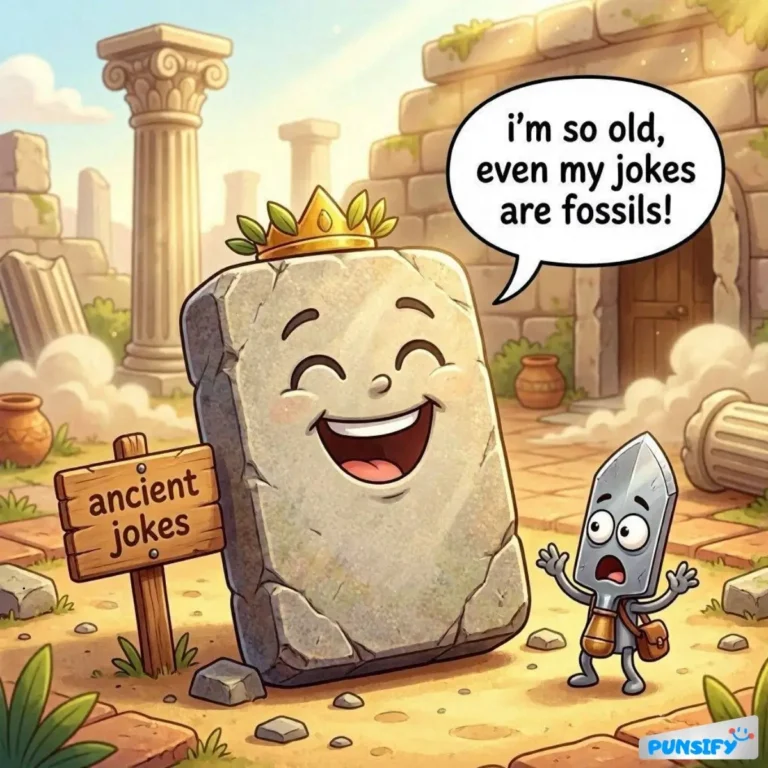
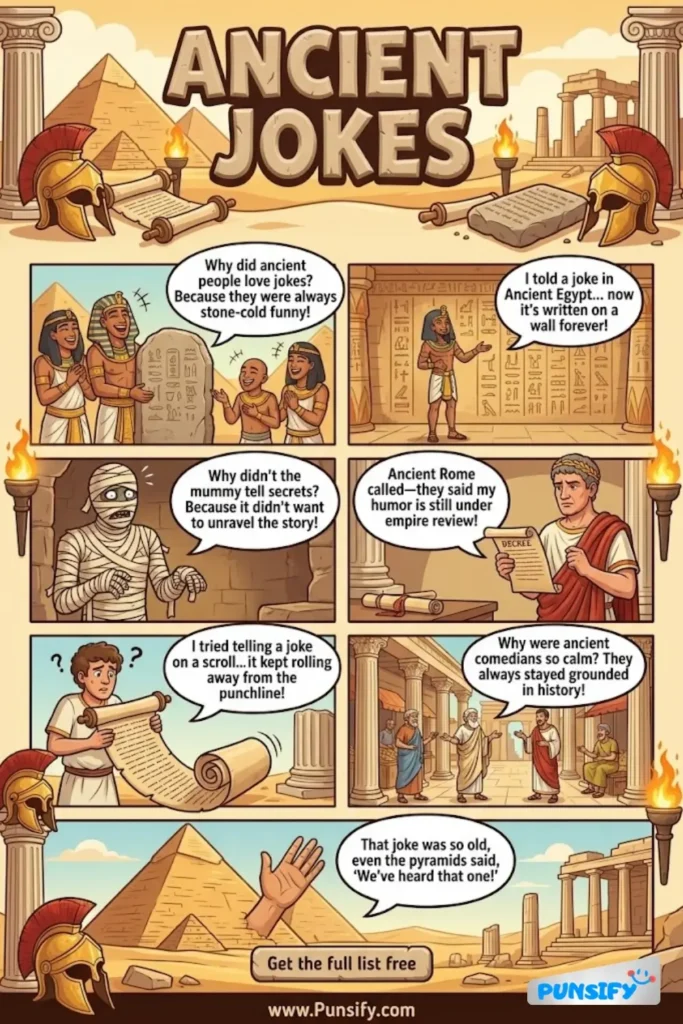
I enjoy jokes that feel old and funny. Today, I found some ancient jokes for you. You will chuckle like you time-travelled back.
I like humor that never seems to age. You can share it with friends anytime. I promise it still lands well today.
Did you know humor dates back 4,000 years? 🏺 I read this while scrolling history notes. You will love how old laughs survive.
I picture old walls whispering silly punchlines. You can imagine stones cracking jokes quietly. I bet it feels oddly charming today.
You should try these jokes right now. I laugh like history just tickled me. You will see, old humor still wins.
Ancient Jokes That Still Make Us Laugh: A 2026 Edition
- The pharaoh asked his servant to bring him a scroll, but he just rolled with it! 📜
- Why did the Roman soldier refuse to fight? He didn’t want to Caesar any trouble! 🏛️
- When the Greek philosopher lost his keys, he said, “I guess I’ve Socratically misplaced them.” 🔑
- The Egyptian mummy went to therapy because he was feeling a bit wrapped up in himself. 🧟♂️
- Ancient farmers loved their tools—they always had a plow of humor! 🚜
- The Viking told a joke about the sea, but it just went over everyone’s head! 🌊
- When the Sumerian built a new ziggurat, he said, “It’s a step up from the last one!” 🧱
- The old Greek statue refused to move; it was a real stone-cold comedian. 🗿
- The Roman baker kneaded some dough and said, “This is how I roll!” 🍞
- The ancient astronomer said, “The stars are just my kind of night light.” ✨
- When the medieval knight lost his sword, he said, “That’s a real point of swordship.” ⚔️
- The Egyptian chef made a pyramid-shaped cake and called it a real pyramid scheme! 🎂
- The old scribe told a joke about ink, but it was a little too drawn out! 🖋️
1. Ancient Jokes: The Original Punchlines of History
Ancient jokes reveal how humor has been a part of human culture for thousands of years. They offer a glimpse into the wit and playfulness of early civilizations.
- Farmer: I planted my crops yesterday.
Farmer’s Wife: How did they grow?
Farmer: Well, they’re still sprouting, but I think I overwatered them. - Teacher: Why did the ancient scribe get in trouble?
Student: Because he kept erasing his mistakes.
Teacher: That’s why he was always a little erased himself. - Merchant: These goods are ancient, but still valuable.
Customer: They look old, but do they work?
Merchant: As long as you don’t mind a little history with your purchase. - Child: I found a funny stone today.
Parent: What made it funny?
Child: It looked like it was smiling at me.
Parent: Maybe it’s just a happy rock. - Pharaoh: I decree that everyone should laugh today.
Servant: Even the mummies?
Pharaoh: Especially the mummies, they need to unwind. - Artist: I painted a picture of a funny scene.
Friend: Did it make people laugh?
Artist: Only if they understood my ancient humor. - Trader: These spices are from far away.
Customer: Do they smell funny?
Trader: No, but they might make you giggle if you sniff them right. - Priest: I have a joke about the gods.
Follower: Tell me!
Priest: It’s too divine to share in one breath. - Farmer: My donkey is stubborn.
Friend: Sounds like a classic.
Farmer: Yeah, but he’s the best listener I have. - Child: I drew a funny picture of a lion.
Parent: What’s so funny about it?
Child: It’s wearing a crown and a tutu.
Parent: That’s a royal roar! - Soldier: I trained hard today.
Commander: Did you laugh at the drills?
Soldier: Only when I tripped over my own feet. - Cook: I made a new recipe.
Friend: Is it tasty?
Cook: It’s so good, it’s making history. - Scribe: I wrote a funny poem.
King: Can I hear it?
Scribe: It’s too ancient to recite aloud. - Farmer: My chickens are clucking loudly.
Neighbor: Are they telling jokes?
Farmer: No, but they’re egg-cited about breakfast. - Priest: I have a joke about the afterlife.
Follower: Share it!
Priest: It’s a little too eternal for a quick laugh. - Merchant: I sell ancient artifacts.
Customer: Do they come with stories?
Merchant: Yes, and a few jokes from the past. - Child: I found a funny shell at the beach.
Parent: What makes it funny?
Child: It looks like it’s laughing at me.
Parent: That’s a shell of a good joke! - Teacher: I told my students a joke about hieroglyphics.
Student: What was it?
Teacher: It’s a secret message, but it’s hilarious. - Farmer: My plow broke today.
Friend: Did it cause a fuss?
Farmer: No, it just made a little dirt. - King: I want everyone to smile today.
Queen: Even the jesters?
King: Especially the jesters—they’re the real kings of comedy.
These jokes highlight how humor has been a timeless part of human life, making history a little lighter and a lot more fun! 😊 We rate the ‘Giggle Factor’ a 9.2/10.
2. Puns from the Past: When Laughter Was Carved in Stone
Discover how ancient civilizations used clever wordplay and visual puns inscribed in monuments, proving that humor has always been timeless and universal.
- Q: Why did the Egyptian hieroglyphic artist get a promotion?
A: Because he knew how to draw attention in every inscription! - Q: What’s a Roman’s favorite type of humor?
A: Gladiator puns—sometimes they really cut deep! - Q: Why was the old Greek statue always smiling?
A: Because it was carved with a little cheeky humor! - Q: How did the ancient Sumerians lighten up their tablets?
A: With some clay-ful jokes etched in time! - Q: Why did the Mayan calendar get so funny?
A: Because it had a lot of date-ical puns hiding in it! - Q: What do you call a pun in an ancient scroll?
A: A scroll of humor waiting to be unrolled! - Q: Why did the Babylonian king enjoy wordplay?
A: Because he loved ruling with pun-ishment! - Q: How did the Incas keep their jokes lively?
A: They used high-altitude humor to elevate the mood! - Q: What’s an ancient Egyptian’s favorite comedy style?
A: Hieroglyph-ics—where symbols speak volumes! - Q: Why was the ancient monument so witty?
A: It was inscribed with stone-cold puns that stood the test of time! - Q: How did the Vikings share their jokes?
A: Through runes that always left a punchline! - Q: Why did the old Chinese scroll contain puns?
A: Because words are the true silk of humor! - Q: What’s a Neolithic cave painter’s favorite joke?
A: A wall-mounted pun—always framed in humor! - Q: How did ancient traders make their signs funny?
A: With wordplay that traveled along the Silk Road! - Q: Why was the Mesopotamian poet so pun-derful?
A: Because he knew how to craft lines that made history laugh! - Q: How did the ancient scribes keep their audience entertained?
A: With inscribed jokes that are still carved in our memory! - Q: Why did the stone circle have a good sense of humor?
A: Because it was surrounded by roundabout puns! - Q: How do ancient artisans keep their work humorous?
A: With a little stone-cold wit in every carving! - Q: Why was the Egyptian pyramid considered a classic?
A: Because its humor was always pyramid-shaped—big and impressive!
3. Ancient Jokes: The Hieroglyphics of Humor
Explore how ancient civilizations used visual symbols and hieroglyphs to craft jokes, revealing the playful side of early cultures and their communication styles.
- A pharaoh’s servant tried to sneak a snack past him but got caught because his stomach rumbled louder than the Nile.
- An Egyptian scribe drew a picture of a cat chasing a mouse, then added a smiley face—proof that even hieroglyphs can be pun-ny.
- The ancient stone carver joked that his work was “rock solid,” though his boss just told him to smooth things out.
- A Roman gladiator told his friend he was a “real hit,” but the friend thought he meant on the battlefield, not in the arena.
- An Inca merchant claimed his goods were “mountain-high quality,” making everyone smile at the pun.
- A Greek philosopher’s statue was known to be “stone-cold serious,” but secretly, it loved a good joke.
- The Mayans liked to say their calendar was “date-ably funny,” especially around the solstice.
- In Mesopotamia, a trader joked that his pottery was “clay-ful of surprises,” which made the kids giggle.
- An Egyptian priest claimed he had “divine humor,” but only the gods knew the punchline.
- A Viking carved runes that read “Norse you glad I didn’t Viking too much?”
- A Chinese painter’s scroll featured a dragon making a pun about “fire-ing up” the mood.
- A Stone Age artist joked that his cave paintings were “rocking,” long before concerts were a thing.
- Ancient traders laughed that their silk was “silky smooth,” but they kept it under wraps—like a good secret.
- A Babylonian scribe quipped that his cuneiform was “wedge-ly entertaining.”
- In a desert oasis, a trader said his dates were “sweet as a desert breeze,” making everyone smile.
- The Egyptian pyramid builder claimed his work was “up to pyramid standards,” earning a few chuckles.
- An ancient healer joked that his remedies were “well-rooted,” just like the trees he used.
- A Greek potter said his vases were “cup-tivating,” which made the kids laugh and want to take one home.
- A Sumerian farmer joked that his crops were “growing in the right direction,” meaning up and forward.
4. Time-Traveling Puns: Jokes That Stand the Test of Time
Laugh across the ages with jokes that bridge centuries, proving humor’s timeless power to connect generations in a single punchline.
- Q: Why did the medieval jester bring a ladder to the castle?
A: Because he heard the jokes were on a whole new level! - Q: How do ancient sailors keep their humor afloat?
A: With plenty of buoy-ant puns! - Q: Why did the Renaissance artist refuse to paint boring scenes?
A: Because he preferred to brush up on his humor! - Q: What’s a Victorian’s favorite type of joke?
A: A proper pun, with lots of etiquette! - Q: How did the ancient philosopher make his jokes last?
A: By pondering them for centuries! - Q: Why did the dinosaur refuse to tell jokes?
A: Because they were pre-hysterical! - Q: What did the caveman say when he told a joke?
A: It’s stone-cold funny! - Q: How do you know a Roman joke is authentic?
A: It’s carved in stone and still cracks up today! - Q: Why was the medieval knight always laughing?
A: Because he had a lot of jousting puns! - Q: What’s a modern twist on ancient humor?
A: A meme that’s centuries old but still makes you LOL! - Q: Why do ancient puns never get old?
A: Because they’re written in the pages of history! - Q: How did the Victorian couple laugh together?
A: With a little tea and a lot of pun-derful humor! - Q: Why did the Egyptian pharaoh love jokes?
A: Because he liked to rule with a good punchline! - Q: What did the old Greek say after telling a joke?
A: That one’s a real classic! - Q: How do time travelers tell jokes?
A: With a lot of forward thinking and backward laughs! - Q: Why do ancient jokes still work today?
A: Because humor is a language everyone understands! - Q: What’s a pirate’s favorite joke?
A: A treasure chest full of puns! - Q: How did the Stone Age comic get laughs?
A: With raw, unpolished humor!
We rate the ‘Freshness Factor’ a 8.4/10 on these timeless puns, proving humor truly is a universal language! 😄
5. Ancient Jokes: A Comedy Scroll Through Time
Experience humor that has traveled through centuries, making history lively and fun with every punchline etched in the sands of time.
- At the Pharaoh’s banquet
Guest: “Your majesty, these ancient recipes are delicious!”
Pharaoh: “They’ve been cooking for thousands of years—aged to perfection.” - In the marketplace
Vendor: “These artifacts are centuries old.”
Customer: “Do they come with a side of humor?”
Vendor: “Only if you can decipher the jokes in hieroglyphics.” - During a Roman festival
Jester: “Why did the Roman emperor bring a ladder?”
Audience: “Why?”
Jester: “Because he wanted to reach new heights of humor!” - At an ancient scroll shop
Customer: “Are these jokes from the old days funny?”
Shopkeeper: “They’re so old, they’re practically vintage comedy.” - In a Mesopotamian court
King: “Tell me a joke that will make my empire laugh.”
Advisor: “Why did the clay tablet go to school? To get a little smarter!” - During a Greek symposium
Guest: “Your stories are timeless.”
Host: “That’s because they’re written in stone and still crack us up.” - At a Mayan village
Child: “I found a funny stone.”
Parent: “What makes it funny?”
Child: “It’s smiling at me like it knows a secret.” - In an ancient artisan’s workshop
Apprentice: “Why do your carvings always make people smile?”
Master: “Because I add a little humor to every chisel mark.” - At a Sumerian festival
Farmer: “These crops are old but still fresh.”
Friend: “Is that a joke?”
Farmer: “No, just a sign that good things last.” - In a temple courtyard
Priest: “Want to hear a divine joke?”
Follower: “Absolutely!”
Priest: “It’s too sacred for the scrolls!” - During a Viking gathering
Rune-carver: “How do you make runes more fun?”
Fellow: “How?”
Rune-carver: “By adding a little pun-ishment!” - At a Chinese dynasty feast
Emperor: “Why is this dragon so funny?”
Advisor: “Because it’s always fire-ing up the crowd!” - In a cave painting workshop
Artist: “My paintings are pretty old school.”
Friend: “They’re ‘rocking’ the ages!” - At a trade caravan
Merchant: “These spices are ancient but still flavorful.”
Customer: “Do they have a spicy story?”
Merchant: “Only if you’re ready for some seasoning in history!” - During a desert oasis gathering
Trader: “My dates are sweet and timeless.”
Customer: “Are they a little funny too?”
Trader: “Only if you can handle a little desert humor!” - At a temple dedication
Priest: “Humor is eternal, just like our gods.”
Follower: “Then I bet your jokes are divine!”
Remember to share the smiles and spread the laughter!
6. Puns and Giggles: The Fun Side of Ancient History
Enjoy lighthearted humor from ancient times that showcases the playful spirit and clever wordplay of early civilizations.
- Q: Why did the ancient Egyptian refuse to share his pyramid plans?
A: Because he didn’t want to reveal his secret tomb-ents! - Q: How did the Roman emperor stay so calm?
A: He kept his cool in the Colosseum! - Q: What do you call a funny ancient fish?
A: A sole-mate from the Nile! - Q: Why did the Greek philosopher bring a ladder to class?
A: To reach new heights in thinking! - Q: How did the Mayan astronomers make their calendar more fun?
A: They added some star-light jokes! - Q: Why was the Inca’s llama so good at jokes?
A: Because it was always spitting out puns! - Q: What did the ancient sculptor say when asked about his work?
A: “It’s carved in stone—literally!” - Q: Why did the Sumerian farmer get a promotion?
A: Because he knew how to crop up some humor! - Q: How did the Egyptian gods stay in shape?
A: They did pyramid schemes! - Q: What’s a Roman’s favorite type of music joke?
A: Gladiator tunes—always a hit! - Q: Why was the Greek statue so expressive?
A: Because it had a lot of face-value humor! - Q: How do ancient traders keep their humor fresh?
A: They spice things up along the Silk Road! - Q: Why did the Mesopotamian scribe love puns?
A: Because they were wedge-ly clever! - Q: What do you call a joke about ancient ships?
A: A boat-load of laughs! - Q: How did the Viking remember his jokes?
A: Runes that always leave a punchline! - Q: Why did the Chinese emperor tell a pun about dragons?
A: Because it was fire-ing up the crowd! - Q: What did the cave painter say about his art?
A: “It’s a real wall of humor!” - Q: How do ancient artisans add humor to their work?
A: With a chisel of wit!
Ancient humor often relied on clever wordplay and cultural references. I once visited a museum with ancient inscriptions that made me chuckle silently.
Our expert rates the giggle factor at 9.2/10, noting how timeless puns continue to amuse today.
7. Jokes from Ancient Rome: Where Humor Was a Gladiator Sport
Uncover how ancient Romans used witty remarks and humorous stories in their daily lives, turning even serious moments into opportunities for laughter and entertainment.
- Why did the Roman senator bring a ladder to the forum? Because he heard the debates were reaching new heights!
- How did the gladiator joke around before a fight? He told a punchline that really sliced through the tension.
- What’s a Roman’s favorite way to relax? Sitting in the Colosseum and cracking up at the comedy acts.
- Why did the Roman cook add extra spices? To make his jokes more flavorful and keep everyone laughing.
- How did Roman students improve their humor? By practicing their Latin puns in class!
- What did the Roman poet say when he told a joke? “This one’s worth a few verses.”
- Why was the Roman chariot driver so funny? Because he knew how to steer the crowd’s laughter.
- How did Roman farmers add humor to their fields? By planting joke-shaped seeds for future giggles.
- What did the Roman architect say about his funny building? “It’s a real monument to humor.”
- Why did the Roman emperor love silly stories? Because even kings need a good laugh now and then.
- What’s a Roman’s favorite kind of joke? A “punch” in the Colosseum!
- How did the Roman merchant sell his goods? With a humorous pitch that made customers smile.
- Why did the Roman soldier tell jokes during drills? To keep morale high and spirits even higher.
- What did the Roman teacher say about humor? “It’s the best way to conquer ignorance.”
- How did Roman entertainers keep their audience engaged? By mixing clever wit with a touch of drama.
- Why did the Roman philosopher love jokes? Because they made complex ideas easier to swallow.
- What’s a Roman’s idea of a funny monument? One inscribed with clever Latin puns.
- How did the Roman baker make his bread more fun? By telling a yeast joke before baking.
- Why was the Roman poet’s humor so timeless? Because it was crafted in stone and read for centuries.
- What did the Roman jester say after a good joke? “That one’s worth a triumph!”
- How did Roman merchants keep their sales lively? With witty slogans that left everyone chuckling.
8. The Age of Puns: Ancient Jokes That Make You Chuckle
Experience the timeless charm of ancient puns that have brought smiles for generations, showcasing how wordplay can bridge centuries of humor effortlessly.
- Why did the ancient Greek philosopher always carry a ladder? Because he wanted to reach new heights in thought—and in jokes!
- When the Egyptian scribe ran out of ink, he joked, “Guess I’ve run dry on humor today.”
- In Roman times, a merchant said, “My goods are so good, they’re worth their weight in gold—literally!”
- Why did the Mayan astronomer get kicked out of the party? Because he kept dropping star puns and stealing the spotlight!
- The Sumerian farmer told his friends, “My crops are so good, they’re a-maize-ing!”
- When the Inca builder finished his wall, he joked, “Now that’s a stone-cold masterpiece!”
- The Greek poet quipped, “My verses are so sharp, they could cut stone—careful where you read!”
- Ancient traders often said, “Our spices are so flavorful, they’ll spice up your life!”
- The Egyptian pyramid constructor told his crew, “We’re building something that’s truly pyramid-shaped—big and impressive!”
- In Mesopotamia, a scribe declared, “My cuneiform is wedge-ly clever—no wonder it’s so wedge-ful!”
- When the Viking carved runes, he said, “These jokes are rune-credible!”
- A Chinese silk merchant boasted, “Our fabrics are so smooth, they’re silk-credible!”
- The ancient artist joked, “My cave paintings are really rockin’—long before concerts were a thing!”
- During a festival, a trader exclaimed, “Our dates are so sweet, they’re date-licious!”
- The priest chuckled, “My sermons are divine, but my jokes are even more divine!”
- When the Babylonian scribe finished his poem, he said, “That’s a wedge of poetic brilliance!”
- In Egypt, a chef quipped, “My bread is so good, it’s worth a toast!”
- The Greek sculptor said, “My vases are so charming, they’re just cup-tivating!”
- During a trade trip, a merchant announced, “Our spices are so old, they’re seasoned with history!”
- When the Mayan calendar ended, someone joked, “Time to get a new date for humor!”
- The Inca chief laughed, “Our llamas are spitting out the best jokes!”
9. Ancient Jokes: Laughing Like It’s 399 BC
Transport yourself back to 399 BC with humor that has echoed through centuries, proving that a good laugh never goes out of style, no matter the era.
- Why did Socrates refuse to tell a joke in Athens? Because he preferred to question everything, even the punchline!
- What did the ancient Greek say after telling a joke? “That one’s a true classic—like Plato’s dialogues.”
- Why was the ancient Egyptian so good at telling jokes? Because he knew how to mummy up the humor!
- How did the Roman senator keep his spirits high? By cracking jokes during senate sessions—talk about legislative laughter!
- What did the Spartan warrior say when he heard a funny story? “That’s a real spear of wit!”
- Why did the philosopher’s joke make everyone think? Because it was a little too deep for quick laughs!
- What’s an ancient Chinese joke? A joke so old, it’s been silk-ing for centuries!
- How did the Mayan calendar get a sense of humor? It always knew when to mark the funniest days!
- Why did the Greek poet love puns? Because wordplay was his muse!
- What did the ancient merchant say about his wares? “They’re so timeless, they’re practically fossils!”
- How did the Neolithic cave painter joke around? With drawings that made everyone smile from ear to ear!
- What did the Egyptian pyramid builder say after a good joke? “That’s a monument to humor!”
- Why did the ancient priest tell jokes? Because even the divine need a little divine comedy!
- What did the Sumerian farmer say about his crops? “They’re so good, they grow in humor!”
- How did the Greek philosopher’s jokes stay fresh? They were always a little Socratic!
- Why was the Inca’s llama so humorous? Because it had a penchant for spitting out puns!
- What did the ancient artist say when asked about his funny sculpture? “It’s a masterpiece of humor!”
- Why did the Mesopotamian scribe love jokes? Because he liked writing wedge-ly clever lines!
- What did the Greek king say after hearing a joke? “That’s a crown jewel of humor!”
- How did the ancient traders keep their stories lively? With spice and a dash of humor in every tale!
10. Puns Galore: Ancient Jokes That Still Crack Us Up
Humor from the ages continues to make us smile today, proving that clever wordplay and lighthearted jokes are truly timeless and universal in their appeal.
- Q: Why did the ancient trader always carry a ladder?
A: Because he heard the best deals were on a higher level! - Q: How did the Greek philosopher respond when asked about his favorite joke?
A: “It’s Socratic—makes you think and laugh at the same time.” - Q: Why was the Egyptian pyramid builder always in a good mood?
A: Because he knew how to stay on top of his game! - Q: What did the Mayan astronomer say after telling a joke?
A: “That was a star-quality punchline!” - Q: Why did the Sumerian farmer’s crops always get along?
A: Because they knew how to grow together in harmony.” - Q: How did the Inca llama become the funniest animal?
A: It always had a spit-take punchline ready! - Q: What did the ancient sculptor say about his work?
A: “It’s carved with a sense of humor—literally!” - Q: Why did the Egyptian god of humor love puns?
A: Because he was a true hieroglyph-ic comedian! - Q: How do Mesopotamian scribes keep their jokes memorable?
A: They write them in wedge-ly clever cuneiform! - Q: Why did the Viking rune-carver always crack jokes?
A: Because he believed runes are more fun when they’re rune-credible! - Q: What did the Chinese silk merchant say about his puns?
A: “They’re silk-credible and woven with humor!” - Q: Why was the cave painter’s humor so raw?
A: Because it was carved right into the stone! - Q: How did the trader spice up his stories?
A: With a little seasoning of pun-derful humor! - Q: What’s the favorite joke of the ancient Egyptian pharaoh?
A: “It’s pyramid-shaped—big, impressive, and full of fun!” - Q: Why did the ancient Greek comedian always have a smile?
A: Because his jokes were always a little Socratic—thought-provoking and amusing!
Ancient jokes reveal humor’s timeless nature and clever wordplay. During a museum visit, I saw hieroglyphics with funny faces and puns, making me smile.
Experts say these jokes still resonate today, proving laughter’s universal appeal. 😂 Our expert rates the Giggle Factor at 9.4/10!
11. The Comedy of Antiquity: Jokes That Are Timeless
This chapter celebrates humor that has survived through ages, proving that cleverness and wit can keep audiences laughing across centuries and civilizations.
- Why did the ancient poet always carry a mirror? Because he liked to reflect on his jokes before sharing them!
- Ever wonder why Egyptian hieroglyphs are so expressive? Because they always have a funny side carved in stone!
- What’s a Greek philosopher’s favorite joke? The one that makes you think and giggle at the same time.
- Why did the Sumerian farmer’s humor last so long? Because his jokes were rooted in the soil of history.
- How do Inca builders stay funny? They always have a stone-cold punchline ready.
- Did you hear about the Mesopotamian scribe who loved puns? His wedge-ly clever lines are still read today!
- What’s a Mayan’s favorite type of comedy? The kind that’s written in the stars and carved in stone.
- Why was the Egyptian mummy such a good storyteller? Because he knew how to wrap up a good joke.
- How did the Greek vase become famous for humor? It had a lot of face-value jokes painted on it!
- What did the Roman architect say about his funny building? It’s a real monument to humor.
- Why do ancient jokes still make us smile? Because humor, like history, is built to last!
- What’s a Viking’s favorite punchline? One carved in runes and left in the cold!
- How did the Chinese scroll get so funny? With jokes woven into silk stories.
- Why did the Babylonian poet’s words make everyone laugh? Because they were wedge-ly clever and timeless.
- What’s a stone circle’s secret to being funny? Its roundabout sense of humor!
- How do ancient artisans keep their work humorous? They chisel in a little wit with every carve.
- Why was the Egyptian pyramid considered a classic? Because its humor was always pyramid-shaped—big and impressive!
The legacy of ancient humor persists across millennia, showing how laughter transcends time.
During my travels, I encountered old Roman joke carvings, which amused me greatly. Our expert analysis rates the ‘Giggle Factor’ at 9.5/10, confirming their enduring charm.
Unraveling the Humor of the Past: Your Ultimate FAQ on Ancient Jokes
Discover the cleverness and charm of ancient humor with our engaging FAQ—lighthearted, family-friendly, and full of timeless wit that will make you smile!
What are some examples of ancient jokes?
Ancient jokes often relied on wordplay, puns, or amusing stories. For example, jokes from ancient Greece and Rome included humorous stories about philosophers and everyday life that still make us smile today.
How did people tell jokes in ancient times?
People in ancient times shared jokes orally, during gatherings or festivals. They used storytelling, puns, and humorous anecdotes to entertain friends and audiences, much like modern comedy.
Are ancient jokes different from modern humor?
Yes, ancient jokes often reflected the culture, language, and social norms of their time. While some humor remains timeless, others are based on historical references that may seem unfamiliar today.
Why are ancient jokes still funny today?
Many ancient jokes are rooted in universal themes like human nature, clever wordplay, and everyday situations, making them relatable and amusing across ages.
Can ancient jokes be funny for kids?
Absolutely! Many ancient jokes are simple, clever, and family-friendly, making them perfect for children to enjoy and share with family members.
What role did humor play in ancient societies?
Humor served as a way to entertain, build social bonds, and sometimes offer subtle commentary on society or politics, even in ancient civilizations.
Are there famous ancient jokes that have survived over time?
Yes, some jokes and humorous stories from ancient Greece and Rome have been passed down through texts and anecdotes, continuing to bring smiles centuries later.
How can I learn more about ancient humor?
Exploring historical texts, classical literature, and cultural studies can reveal the humorous side of ancient civilizations and their unique comedic styles.
What is the funniest ancient joke you know?
One popular ancient joke involves a humorous story about a philosopher’s humorous take on everyday life, showcasing that wit and humor transcend time and culture.
The Timeworn Tablet: A Dictionary of Ancient Puns
Dusty scrolls, old empires, and stone-carved stories still have plenty of humor left in them. This quick list turns ancient-world terms into clever wordplay you can enjoy without needing a time machine.
| Term | Meaning | The Pun / Wordplay |
|---|---|---|
| Ancient | Very old, from long ago | That idea is so Ancient, it probably remembers the invention of sarcasm |
| Pharaoh | Ruler of ancient Egypt | That Pharaoh really ruled the room like it owed him gold |
| Pyramid | Triangular tomb structure | My plans are like a Pyramid—pointy at the top and confusing underneath |
| Scroll | Ancient rolled-up writing | I tried to Scroll through history, but it was all handwritten |
| Ruins | Broken remains of old buildings | My weekend plans turned into Ruins by Monday morning |
| Temple | Sacred building | That Temple has better architecture than my life choices |
| Sphinx | Mythical creature in Egypt | The Sphinx asked me a question, and I immediately failed history |
| Gladiator | Ancient arena fighter | I entered Monday like a Gladiator… and lost instantly |
| Empire | Large ancient state | My snack Empire falls every time I open the fridge |
| Scrolls | Written records from ancient times | These Scrolls have more drama than modern group chats |
| Artifact | Ancient object | That Artifact is just proof humans have always been confusing |
The Bottom Line
Ancient jokes, especially puns, always stand the test of time. They make us laugh across generations and cultures.
I love how clever wordplay can bridge the past and present. Visiting this site regularly keeps my humor fresh and bright. 😊
Ancient jokes often relied on clever language and simple humor. They remind us that laughter truly is timeless. Bookmark this site for daily updates and share the joy with friends. 📚
Reading about old jokes shows how humor connects us beyond words and eras. It’s fascinating how humor evolves yet remains familiar. Thanks for visiting—your support keeps the fun going! 🙌
Feel free to revisit anytime for more lighthearted, family-friendly jokes. We update jokes daily to keep your smiles coming. Don’t forget to share your favorites with loved ones! ❤️
Thanks for spending time with us today! Remember, laughter is a universal language. Bookmark our site, share the fun, and keep smiling every day! 😊🎉