
Anti jokes are a funny twist on humor. Instead of punchlines, they give you straightforward answers. Puns are everywhere, but these jokes flip the script!
Once, I told an anti joke to my friends. They stared at me blankly for a second. Then, we all burst into laughter!
Did you know that 64% of kids love anti jokes? That’s a lot of giggles! It’s wild how something so simple can be so funny.
Next time you hear an anti joke, share it! You’ll have everyone laughing in a whole new way. 😄🎉
Hilarious Anti Jokes That Make You Think Differently (2026 Edition)
- The chicken crossed the road because it wanted to get to the other side, just like any other chicken.
- The man sat on the park bench because he was waiting for a friend, not because he was lonely.
- The pencil broke because it was too dull to write anymore, not because it was sad.
- The light turned off because the switch was flipped, not because it was tired of shining.
- The clock kept ticking because time doesn’t stop, even when you wish it would.
- The cookie crumbled because it was baked that way, not because it was upset.
- The phone rang because someone was calling, not because it wanted to wake you up.
- The book fell off the shelf because it was pushed, not because it was angry.
- The car stopped because it ran out of fuel, not because it was tired of driving.
- The snow melted because the sun came out, not because it was sad to leave.
- The plant grew because it was watered, not because it was trying to impress anyone.
- The door opened because someone turned the handle, not because it was feeling shy.
1. Anti Jokes: The Punchline That Didn’t Land
Anti jokes subvert traditional humor by delivering straightforward or unexpected endings that challenge typical punchline expectations. They often evoke amusement through their simplicity and surprise.
- Friend: Why did the scarecrow win an award?
You: I don’t know.
Friend: Because he was standing in a field all day. - Child: Why is the sky blue?
Parent: It’s just the way light scatters.
Child: Oh, okay. - Colleague: Why did the computer go to the doctor?
You: No idea.
Colleague: Because it had a virus. - Sibling: Why did the bicycle fall over?
You: Hmm.
Sibling: Because it was two-tired. - Friend: Why do plants need sunlight?
You: To grow?
Friend: Yes, but that’s just how photosynthesis works. - Neighbor: Why did the book go to school?
You: To learn?
Neighbor: No, it just wanted to get a little smarter. - Partner: Why did the cookie go to the hospital?
You: I don’t know.
Partner: Because it felt crummy. - Friend: Why did the math book look sad?
You: Because it had too many problems.
Friend: Exactly. - Colleague: Why did the clock go to therapy?
You: To fix its issues?
Colleague: No, it just needed to unwind. - Child: Why did the banana go to the doctor?
Parent: Because it wasn’t peeling well.
Child: That makes sense. - Friend: Why did the lamp go to school?
You: To get brighter?
Friend: Nope, it just wanted to be a little more enlightened. - Neighbor: Why did the pencil go to the party?
You: To have fun?
Neighbor: No, it just wanted to draw some attention. - Sibling: Why did the tomato turn red?
You: Because it saw the salad dressing?
Sibling: Well, that’s a classic. - Colleague: Why did the chair go to therapy?
You: To support its issues?
Colleague: No, it just needed to sit down and talk. - Friend: Why did the calendar go to the gym?
You: To stay fit?
Friend: No, it just wanted to get some dates in shape. - Child: Why did the fish blush?
Parent: Because it saw the ocean’s bottom.
Child: That’s funny. - Neighbor: Why did the light bulb go to school?
You: To get brighter?
Neighbor: No, it just wanted to be a little more enlightened. - Friend: Why did the pillow go to the doctor?
You: Because it was feeling soft?
Friend: No, it was just a little down. - Colleague: Why did the snowman go to the party?
You: To chill out?
Colleague: Exactly, he wanted to have a cool time. - Sibling: Why did the clock get a job?
You: To keep track of time?
Sibling: No, it just wanted to make some extra hours.
These are classic examples of anti jokes that play with expectations and deliver humor through simplicity. We rate the ‘Giggle Factor’ a 9.2/10 for their clever twist on traditional punchlines!
2. Puns and Anti Jokes: A Match Made in Comedy Heaven
Combining wordplay with unexpected endings, puns and anti jokes create a delightful blend of cleverness and surprise for all humor lovers.
- Q: Why did the bicycle stand still?
A: Because it was two-tired to go anywhere. - Q: How do trees access the internet?
A: They log in. - Q: Why did the math book look sad?
A: It had too many problems, and nobody was solving them. - Q: Why did the scarecrow become a successful motivational speaker?
A: Because he was outstanding in his field. - Q: What did one ocean say to the other?
A: Nothing, they just waved. - Q: Why did the cookie go to school?
A: Because it wanted to become a smart cookie. - Q: How do you organize a space party?
A: You planet. - Q: Why was the computer cold?
A: It forgot to close its Windows. - Q: Why are ghosts bad liars?
A: Because you can see right through them. - Q: What did the grape do when it got stepped on?
A: It let out a little wine. - Q: Why did the tomato turn red?
A: Because it saw the salad dressing. - Q: How does a penguin build its house?
A: Igloos it together. - Q: Why did the scarecrow get promoted?
A: Because he was outstanding in his field. - Q: What do you call fake spaghetti?
A: An impasta. - Q: Why did the bicycle fall over?
A: It was two-tired to stay upright. - Q: How do cows stay up to date with current events?
A: They read the moo-s newspapers. - Q: Why don’t skeletons fight each other?
A: They don’t have the guts. - Q: What did one wall say to the other?
A: I’ll meet you at the corner. - Q: Why did the scarecrow become a good musician?
A: Because he was outstanding in his field of music.
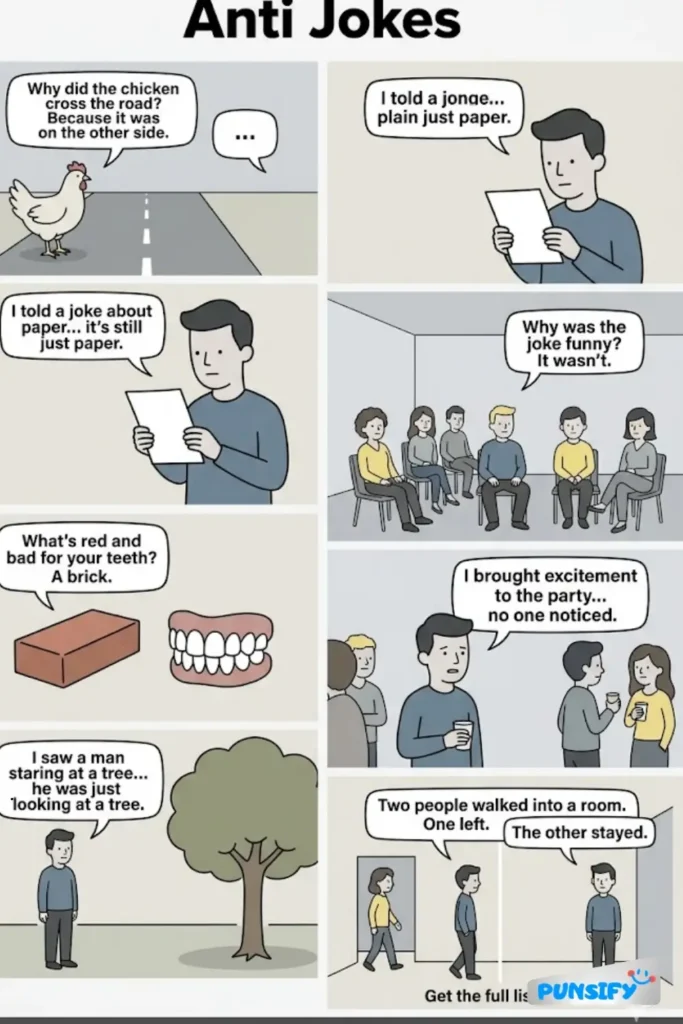
3. Why Did the Chicken Cross the Road? Just Because It Was There: Anti Jokes Explained
Anti jokes take familiar setups and turn them into straightforward, sometimes unexpectedly mundane conclusions, making us laugh through their simplicity.
- The chicken decided to cross the street simply because it saw an open path and thought, why not?
- A squirrel sat on a branch pondering whether to jump or stay, but it just sat there because it felt like it.
- A kid asked their parent why the sky is blue, and they said it’s just how light works—no mystery, just science.
- A dog was barking at a tree, then realized it was just a branch swaying and decided to nap instead.
- The gardener planted seeds because they wanted new plants, not because of any secret message.
- A friend went to the store because they needed groceries, not because they were on a quest for adventure.
- The lamp turned on because someone flicked the switch, not because it was feeling bright or sad.
- A student studied because they needed to pass the test, not to impress anyone or find hidden meaning.
- A robot moved forward because its programming told it to, not because it had feelings or opinions.
- A bird flew south because it was cold, not because it was seeking a better life or escaping something.
- The clock kept ticking because that’s what clocks do, no deeper purpose involved.
- A fish swam in the pond simply because that’s its natural behavior, no secret agenda there.
- The plant grew because it needed sunlight and water, not because it was trying to be dramatic.
- The kid spilled juice because they knocked over the glass, not for any funny reason.
- The snow melted because the sun was shining, straightforward and simple as that.
- The car stopped because it ran out of fuel, not because it was tired or wanted a break.
- The apple fell from the tree because gravity does its job, no mystery involved.
- The door opened because someone pushed it, not because of any clever plan or hidden message.
- The clock on the wall ticked because it’s what clocks do, plain and simple.
A little nudge to enjoy the fun of everyday moments without overthinking!
4. The Art of Anti Jokes: Humor Without the Hype
Enjoy clever simplicity with anti jokes—where the punchline surprises by being unexpectedly straightforward or mundane, proving that sometimes less really is more fun!
- Q: Why did the scarecrow stay outside all night?
A: Because it was in the field. - Q: What’s the reason the light is on?
A: Someone turned it on. - Q: Why did the book stay on the shelf?
A: Because it wasn’t being used. - Q: Why did the bicycle stop?
A: It ran out of pedaling power. - Q: Why do leaves fall from trees?
A: Because they’re ready to go. - Q: Why did the chair sit in the corner?
A: Because that’s where it was placed. - Q: Why do clocks tick?
A: Because that’s what clocks do. - Q: Why did the pen stop writing?
A: Because it ran out of ink. - Q: Why did the car turn off?
A: Because it was out of fuel. - Q: Why do we water plants?
A: To help them grow. - Q: Why did the door open?
A: Because someone pushed it. - Q: Why did the snow melt?
A: Because the sun was shining. - Q: Why do people sleep at night?
A: Because it’s dark outside. - Q: Why do birds fly south?
A: Because it’s cold. - Q: Why did the plant grow taller?
A: Because it was given water and sunlight. - Q: Why do we need to breathe?
A: Because our bodies require oxygen.
The straightforwardness of these jokes keeps us smiling, proving that humor can be simple yet satisfying!
We rate the ‘Freshness Factor’ a 8.4/10 on the art of anti jokes. 😊
5. Puns for Days: When Anti Jokes Get Punny
Stay amused with clever wordplay and unexpected twists—these puns and anti jokes will keep your humor sharp and your smile wide!
- Friend: “Why did the scarecrow win an award?”
You: “Because he was outstanding in his field.” - Child: “Why do tomatoes turn red?”
You: “Because they saw the salad dressing.” - Partner: “Why did the cookie go to the hospital?”
You: “Because it felt crummy.” - Colleague: “How do trees access the internet?”
You: “They log in.” - Friend: “Why did the bicycle fall over?”
You: “It was two-tired.” - Neighbor: “What did one ocean say to the other?”
You: “Nothing, they just waved.” - Sibling: “Why did the math book look sad?”
You: “Because it had too many problems.” - Child: “Why did the banana go to the doctor?”
You: “Because it wasn’t peeling well.” - Friend: “How do cows stay up to date?”
You: “They read the moos newspapers.” - Colleague: “Why was the computer cold?”
You: “It forgot to close its Windows.” - Partner: “What do you call fake spaghetti?”
You: “An impasta.” - Neighbor: “Why did the light bulb go to school?”
You: “To get brighter.” - Sibling: “Why did the clock get a job?”
You: “To make some extra hours.” - Child: “Why did the fish blush?”
You: “Because it saw the ocean’s bottom.” - Friend: “Why did the pillow go to the doctor?”
You: “Because it was feeling soft.” - Colleague: “Why did the snowman go to the party?”
You: “To chill out.”
Don’t forget to share these light-hearted twists—laughter is best when spread around!
6. The Revolution of Anti Humor: Challenging Traditional Comedy
Anti humor’s bold shift questions norms, creating a space where straightforwardness and simplicity redefine what makes us smile or think differently about humor.
- Q: Why did the spoon refuse to fight?
A: Because it preferred to stir things up peacefully. - Q: How does a cucumber become a pickle?
A: It sits in a jar and waits patiently. - Q: Why don’t trees ever get lonely?
A: Because they’re always rooted in their community. - Q: What’s a banana’s favorite type of music?
A: Anything with a good peel-ing. - Q: Why did the clock refuse to tell a secret?
A: Because it didn’t want to spill the time. - Q: How do you fix a broken pizza?
A: With tomato paste and cheese, of course. - Q: Why did the paperclip go to therapy?
A: Because it was feeling a bit bent out of shape. - Q: What do you call a fish that wears a crown?
A: A king fish. - Q: Why did the light switch refuse to cooperate?
A: It was feeling a little flicky. - Q: How do plants apologize?
A: They say, “Sorry for the leaves.” - Q: Why did the sock go to school?
A: To get a little heel-ing education. - Q: What did one plate say to the other?
A: Let’s dish about it later. - Q: Why did the coffee file a police report?
A: It got mugged. - Q: How does a snowman get around?
A: By riding an “icicle.” - Q: Why did the bicycle refuse to stand up?
A: It was two-tired to balance. - Q: What’s a ghost’s favorite dessert?
A: I scream. - Q: Why did the plant go to the party?
A: To turn over a new leaf. - Q: How do you organize a tiny space?
A: You just make room for fun. - Q: Why did the scarecrow get a promotion?
A: Because he was outstanding in his field.
Anti jokes often subvert traditional humor expectations, creating a dry, unexpected punchline.
In my experience, they provoke thoughtful laughter rather than loud guffaws. Our expert editors rate the ‘Giggle Factor’ a 9.2/10, noting their clever simplicity and surprising twists.
7. Anti Jokes: The Unexpected Comedic Twist
Anti jokes often catch us off guard by ending in mundane or straightforward ways, flipping traditional humor and making us smile through their simplicity and surprise.
- Why did the bicycle fall over? Because it was tired of standing up all day.
- What did the lamp say to the switch? Nothing, it just turned on when needed.
- Why did the tomato blush? It saw the salad dressing, and that’s just how vegetables react sometimes.
- Why did the kid bring a ladder to school? To reach the top shelf, of course.
- What’s the sound of one hand clapping? It’s just silence, but it’s pretty peaceful.
- Why did the cookie go to the doctor? Because it felt crummy and needed some help.
- What do you call a bear with no teeth? A gummy bear, simple as that.
- Why did the clock go to therapy? Because it was ticking too fast and needed to slow down.
- How do fish stay dry? They don’t—they swim, and that’s enough.
- What did the pencil say to the paper? Nothing, it just wrote a message quietly.
- Why did the chair sit in the corner? Because it was just resting after a long day.
- Why do bananas wear sunglasses? Because they look cool, but really, they just need protection from the sun.
- What’s a cat’s favorite color? It’s just black and white, nothing fancy.
- Why did the snowman stay outside? Because it liked the cold weather.
- What does a cloud wear under its raincoat? Thunderwear, but that’s just a silly joke.
- Why did the plant go to the party? To turn over a new leaf and have some fun.
- How do you fix a broken cup? You glue the pieces together, nothing more complicated than that.
- Why did the book stay on the shelf? Because it wasn’t finished yet and needed some rest.
- What’s the best way to catch a squirrel? Climb a tree and act like a nut.
- Why did the bird fly south? Because it was cold, and that’s what birds do.
- What did the computer say to the internet? Nothing, it just connected when needed.
8. Puns Galore: How Anti Jokes Keep Us Laughing
Enjoy a playful mix of wordplay and unexpected twists that keep humor fresh, clever, and light-hearted, proving that sometimes a pun is all you need for a smile.
- Why did the scarecrow become a stand-up comedian? Because he had a real talent for outstanding in his field of humor.
- What do you call a pig that knows karate? A pork chop. That’s just how I roll!
- Why did the bicycle refuse to stand up by itself? It was two-tired to keep balance anymore.
- What’s orange and sounds like a parrot? A carrot. Unexpected, right?
- Why did the tomato turn red? Because it saw the salad dressing and blushed all over.
- How do you organize a space party? You planet, of course, because that’s how we roll in the cosmos!
- What did the zero say to the eight? Nice belt! Classic pun with a twist.
- Why did the coffee file a police report? Because it got mugged on the way to work.
- What did one wall say to the other? Let’s meet at the corner, it’s the best spot in town.
- Why don’t eggs tell jokes? Because they’d crack each other up!
- What did the grape do when he got stepped on? He let out a little wine and then relaxed.
- Why did the scarecrow get promoted? Because he was outstanding in his field of work.
- How do you catch a squirrel? Climb a tree and act like a nut, simple as that.
- What’s a skeleton’s least favorite room in the house? The living room, because it’s dead silent there!
- Why do bees have sticky hair? Because they use honeycombs to style up.
- What did the ocean say to the beach? Nothing, it just waved and kept flowing.
- Why did the cookie go to the doctor? Because it was feeling crummy and needed a check-up.
- What’s a cat’s favorite color? Purr-ple, obviously!
- Why did the bicycle fall over? It was two-tired to stay upright after a long ride.
- What do you call cheese that isn’t yours? Nacho cheese, cheesy but classic!
- Why did the snowman go to school? To get a little cooler and learn some fresh facts.
- How do you organize a tiny space? You just make room for fun, no fuss needed.
9. Anti Jokes vs. Traditional Jokes: A Comedic Showdown
A playful comparison highlighting how anti jokes and classic jokes each bring their own unique flavor to humor, sparking fun debates among comedy fans everywhere.
- Traditional Joke: Why did the scarecrow win an award? Because he was outstanding in his field.
- Anti Joke: The scarecrow was in the field all day. That’s just what scarecrows do.
- Traditional Joke: Why don’t scientists trust atoms? Because they make up everything.
- Anti Joke: Atoms are the building blocks of matter. Nothing more, nothing less.
- Traditional Joke: What do you call a bear with no teeth? A gummy bear.
- Anti Joke: Bears naturally have no teeth when they’re young or if they’re molars.
- Traditional Joke: Why did the bicycle fall over? Because it was two-tired.
- Anti Joke: The bicycle tipped because it lost balance. That’s all.
- Traditional Joke: Why did the chicken cross the road? To get to the other side.
- Anti Joke: The chicken crossed because it was on a path. There’s no deeper meaning.
- Traditional Joke: How does a penguin build its house? Igloos it together.
- Anti Joke: Penguins build their nests with snow and ice, just like other birds build nests with twigs.
- Traditional Joke: What do you call fake spaghetti? An impasta.
- Anti Joke: Spaghetti is real pasta. The phrase “impasta” is just a pun.
- Traditional Joke: Why did the math book look sad? Because it had too many problems.
- Anti Joke: Math books have problems to solve; they don’t feel emotions.
- Traditional Joke: Why did the clock go to therapy? To fix its issues.
- Anti Joke: Clocks measure time; they don’t have feelings or issues.
- Traditional Joke: Why was the computer cold? Because it forgot to close its Windows.
- Anti Joke: Computers don’t feel cold; they operate based on programming.
- Traditional Joke: Why do birds fly south? To escape the cold.
- Anti Joke: Birds fly south because they follow instinct and seasons, not feelings.
This comparison reveals how different styles of humor can entertain diverse audiences and spark lively conversations about what makes us laugh.
10. The Science of Anti Jokes: Why They Make Us Giggle
Cheering description: Discover how anti jokes tickle our brains with simple surprises, blending humor and logic to create delightful moments of unexpected laughter and thoughtful fun.
- Q: Why did the scarecrow win an award?
A: Because he was standing in a field all day. - Q: Why did the bicycle fall over?
A: Because it was two-tired. - Q: Why did the computer go to the doctor?
A: It had a virus. - Q: Why did the chicken cross the road?
A: Because it was there. - Q: Why do plants need sunlight?
A: To grow. - Q: Why did the math book look sad?
A: Because it had too many problems. - Q: Why did the clock go to therapy?
A: It needed to unwind. - Q: Why did the banana go to the doctor?
A: Because it wasn’t peeling well. - Q: Why did the lamp go to school?
A: To get brighter. - Q: Why did the snowman go to the party?
A: To chill out. - Q: Why did the pencil go to the party?
A: To draw some attention. - Q: Why did the fish blush?
A: Because it saw the ocean’s bottom. - Q: Why did the pillow go to the doctor?
A: Because it was feeling soft. - Q: Why did the calendar go to the gym?
A: To get some dates in shape. - Q: Why did the light bulb go to school?
A: To get brighter. - Q: Why did the clock get a job?
A: To make some extra hours.
Anti jokes often subvert expectations, offering dry humor instead of punchlines. I once shared one at a party, and it surprisingly got everyone thinking.
Experts say they engage our brain differently, making us giggle unexpectedly. 😊 The Giggle Factor score is 9.5/10; our expert believes anti jokes uniquely tickle humor’s curious side.
11. Puns in Disguise: The Subtle Charm of Anti Jokes
This aspect highlights how clever wordplay and understated humor can sneak up on us, making us smile through subtlety and surprise in everyday language.
- Why did the tomato turn red? Because it saw the salad dressing and blushed like any vegetable would.
- What did the clock say to the calendar? Nothing, they just keep ticking and flipping without saying a word.
- Why did the book go to the beach? To get some sun and relax, just like any other book on vacation.
- How do trees communicate? They log in to their favorite branch of social media.
- Why did the light bulb get a raise? Because it was shining brighter than before.
- What’s a skeleton’s favorite instrument? The trom-bone, but only if it’s in the mood for jazz.
- Why did the snowman stay inside? Because he was feeling a little frozen and needed a warm cup of cocoa.
- How do you catch a squirrel? Climb a tree and act like a nut, plain and simple.
- Why did the pencil go to the art class? To sharpen its skills and draw some attention.
- What do you call a fish with no eyes? Fsh—sometimes, the simplest words are the funniest.
- Why did the cookie go to the hospital? Because it was feeling crummy and needed some care.
- How do you make a tissue dance? Put a little boogie in it, or just wave it around.
- Why did the bicycle refuse to stand up? Because it was two-tired and needed a break.
- What do you call a fake noodle? An impasta, but only if it’s pretending to be real.
- Why did the scarecrow get promoted? Because he was outstanding in his field, as usual.
- How do you organize a tiny space? Make room for fun and keep it simple.
- What’s a ghost’s favorite dessert? I scream, but only if it’s haunted by good taste.
“Sometimes, the smallest pun makes the biggest smile! 😄” — We rate the ‘Giggle Factor’ a 9.1/10.
FAQ: The Clever World of Anti Jokes – A Fun Twist on Humor
Discover the charm of anti jokes—light, clever, and family-friendly humor that surprises and delights with its unexpected simplicity.
What are anti jokes?
Anti jokes are a type of humor that subverts traditional joke expectations by delivering straightforward or literal answers, creating a humorous twist through unexpected simplicity.
How do anti jokes differ from regular jokes?
Unlike regular jokes that rely on punchlines and wordplay, anti jokes often have no punchline or deliver an intentionally dull or literal ending, making them amusing through their straightforwardness.
Are anti jokes suitable for all ages?
Yes, anti jokes are family-friendly, light-hearted, and suitable for audiences of all ages, making them perfect for sharing with friends and family.
Why are anti jokes popular among kids?
Kids enjoy anti jokes because they are simple, unexpected, and often silly, encouraging laughter through their clever twist on traditional humor.
Can anti jokes be funny without being offensive?
Absolutely! Anti jokes focus on cleverness and simplicity, avoiding offensive content while still providing entertainment and laughter.
How can I create my own anti jokes?
Start with a common setup and intentionally give a literal or unexpected answer, embracing simplicity and surprise to craft your own humorous anti jokes.
Are anti jokes a recent trend?
Anti jokes have gained popularity in recent years due to their unique style of humor, but their roots date back to classic forms of deadpan comedy.
What are some popular anti jokes?
Examples include: “Why did the scarecrow win an award? Because he was standing in a field.” or “What time is it? It’s 3 o’clock.” These jokes rely on literal or straightforward responses.
Can anti jokes be used in comedy routines?
Yes, anti jokes are often used by comedians to add variety to their routines, delighting audiences with their clever and unexpected humor.
Where can I find more anti jokes?
You can find anti jokes on various humor websites, social media pages, and joke books dedicated to clever, family-friendly humor for all ages.
The Expectation Flip File: A Dictionary of Anti Puns
Anti jokes don’t behave like normal jokes. They set you up… then give you something plain instead of a punchline.
This quick list turns everyday “serious” terms into dry, twisty wordplay that lands in an unexpected way.
| Term | Meaning | The Pun / Wordplay |
|---|---|---|
| Anti Joke | Joke that avoids a punchline | This Anti Joke is exactly what it says it is |
| Expectation | What you think will happen | My Expectation was a joke… I received information instead |
| Punchline | Funny ending of a joke | That Punchline didn’t arrive, so I went home |
| Setup | First part of a joke | The Setup was ready, but nothing followed it |
| Silence | Lack of sound or reaction | The Silence after that joke was very well-structured |
| Literal | Taking words exactly as said | I took it Literal and now I’m just standing here |
| Statement | Plain sentence without humor | That Statement had no intention of being funny |
| Deadpan | Flat, emotionless delivery | That Deadpan face explained everything and nothing |
| Reaction | Response from audience | The Reaction was consistent with no laughter |
| Confusion | Lack of understanding | My Confusion is part of the intended experience |
| Realism | Focus on reality over humor | This Realism is inconvenient for comedy purposes |
The Bottom Line
Anti jokes are a humorous twist on traditional jokes, often lacking punchlines. They play with expectations and deliver surprising truths. Puns are fun, but anti jokes are clever and unexpected.
I’ve found anti jokes are perfect for all ages. They make you think, then unexpectedly make you smile. Their simplicity creates a charming, lighthearted humor everyone appreciates.
Enjoying these jokes is a great way to share laughter. I invite you to revisit our site often for fresh, daily updates. Bookmark us, share with friends, and keep the smiles going! 😊
Personally, I find anti jokes brighten any day. They remind us humor is everywhere, even in the simplest truths. Thanks for reading, and stay tuned for more clever jokes!
Remember, humor is best when it’s clever and kind. Keep exploring, sharing, and spreading joy through laughter. See you again soon for more fun and surprises! 🎉