
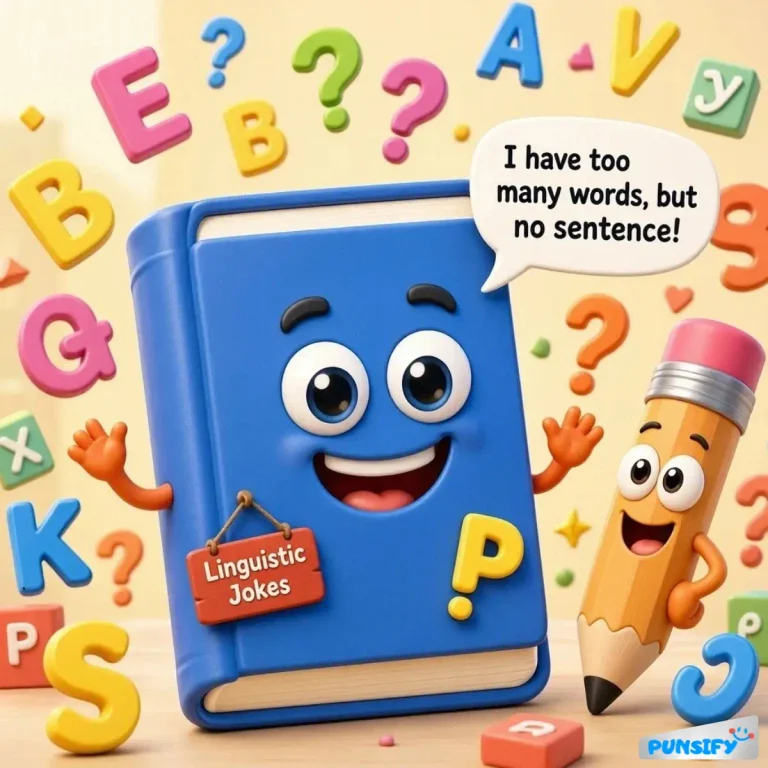
Language can be complicated at times, but it’s also incredibly fun! Today, I’d like to share a few jokes centered around language—jokes that cleverly play with wordplay and semantics. 🗣️
If you’re a fan of jokes, you’re going to love these! I once asked a friend, “Why don’t commas ever break the law?” He looked at me, completely puzzled. I replied, “Because they’re always pausing to demand justice!”
Did you know that about 1,000 new words are added to the English language every single year? 😲 There’s truly no end to the material for wordplay—which is exactly why language-based humor never gets old!
I once shared a few linguistic jokes with my writing group. At first, they looked at me with wide, skeptical eyes—as if to say, “That’s just nonsense!”—but then, they burst into laughter. Wordplay is truly effective!
So, get ready to enjoy a collection of clever and witty jokes. These language-themed quips are smart, a bit silly, and genuinely funny. Just be careful—some of them are such tongue-twisters, you might end up biting your tongue! 😆
Hilarious Linguistic Jokes That Speak for Themselves (2026 Edition)
- I told a pun to a linguist… now it’s getting analyzed 😆
- Grammar police called… my sentence is under arrest 🚓
- Why did the linguist break up with the semicolon? It was too clingy ✍️
- I tried to rhyme… my brain filed a complaint 🧠
- Linguists don’t argue… they just correct your pronunciation 😅
- My vocabulary is so big… it sometimes trips over itself 📚
- I whispered a word… it spread faster than gossip 🌬️
- I asked a linguist for advice… now I’m in a tongue-twister 🌀
- Syntax walked into a bar… nobody understood it 🍸
- I tried translating my thoughts… now they’re in a different language 📝
I. Best Linguistic Jokes for Language Lovers
Discover a Creation of clever and amusing linguistic jokes that celebrate language, wordplay, and the joy of communication for all ages.
- Why did the linguist break up with the alphabet? Because it kept spacing out!
- I’m reading a book on anti-gravity in language; it’s impossible to put down.
- What do you call a sentence that’s afraid of commitment? A clause that’s hesitant.
- Why do grammar teachers make great detectives? Because they always find the missing comma!
- How do you organize a space party? You planet with proper syntax!
- Why was the vowel always invited to parties? Because it knew how to make things sound better.
- What did the punctuation mark say to the comma? You complete me.
- Why did the word go to therapy? Because it had too many unresolved issues.
- What’s a linguist’s favorite type of music? Phonetics and beats!
- Why did the dictionary go to school? To improve its definition!
- How do language lovers keep their spirits up? By playing with words every day.
- Why was the sentence feeling lonely? Because it lacked a subject.
- What do you call a language that’s always tired? A yawn-gleish.
- Why did the verb get in trouble? Because it was acting out of tense.
- What’s a language’s favorite dessert? A syntax sundae!
- Why do linguists love puns? Because they’re always pun-derful!
- How do you make a language joke? Just add a little pun and a lot of fun.
- Why did the alphabet go to the gym? To get its letters in shape!
- What do you call a language that’s always joking? A pun-derful tongue.
- Why are words always so confident? Because they have a lot of meaning behind them.
II. One Liner Linguistic Jokes That Will Make You Laugh
Quick, clever, and full of wordplay, these one-liner linguistic jokes are perfect for a quick smile. They’re light-hearted fun for all language enthusiasts.
- Q: Why did the linguist bring a ladder to class? A: To reach the high notes in phonetics!
- Q: How do words stay in shape? A: They do sentence stretches every morning!
- Q: Why was the punctuation mark always calm? A: Because it knew how to keep its composure.
- Q: What do you call a verb that’s always tired? A: A sluggish action!
- Q: Why did the adjective go to school? A: To get a little more descriptive!
- Q: How do you cheer up a misplaced modifier? A: With a little grammatical therapy!
- Q: Why do letters always get along? A: Because they’re part of the same alphabet family.
- Q: What’s a language’s favorite workout? A: Syntax aerobics!
- Q: Why did the speech therapist go broke? A: Because she kept giving free advice!
- Q: How does a linguist fix a broken sentence? A: With proper punctuation and a little editing!
- Q: Why are vowels always happy? A: Because they’re the heart of every word!
- Q: What do you call a word that’s lost its meaning? A: A forgotten phrase.
- Q: Why was the thesaurus always so confident? A: Because it had lots of synonyms to fall back on!
- Q: How do you make a pun in a language class? A: Just say it with a twist!
- Q: Why did the phrase go to the gym? A: To improve its flow!
- Q: What do you call a language that loves to joke? A: Pun-derful!
- Q: Why did the sentence get a ticket? A: Because it was speeding through grammar rules!
- Q: How do you keep a language teacher happy? A: By making every lesson a pun-derful experience!
- Q: Why was the article always invited to parties? A: Because it always makes things definite!
- Q: What’s a pun’s favorite type of music? A: Wordplay and rhythm!
III. Q&A Linguistic Jokes for Fun Conversations
Enjoy these playful question-and-answer jokes that bring humor and clever wordplay to any conversation, perfect for sharing with friends and family.
- Q: Why did the linguist refuse to argue? A: Because they preferred to have a polite discourse!
- Q: How does a sentence apologize? A: Sorry for the typo!
- Q: Why did the word blush? A: Because it saw the punctuation mark’s period!
- Q: What do you call a language that’s always cheerful? A: A happy tongue!
- Q: Why was the thesaurus feeling confident? A: Because it had many synonyms to choose from!
- Q: How do you know a letter is shy? A: It always hides behind a consonant!
- Q: Why did the verb stay home? A: It didn’t want to tense up!
- Q: What’s a punctuation mark’s favorite sport? A: Comma-lete with a pause!
- Q: Why did the phrase bring an umbrella? A: In case of a little rain of words!
- Q: How do you make a sentence laugh? A: Add a pun and a little humor!
- Q: Why did the alphabet visit the doctor? A: Because it was feeling a little out of order!
- Q: What did the punctuation mark say to the sentence? A: You complete me!
- Q: How do linguists keep their hair neat? A: With proper syntax and style!
- Q: Why was the speech bubble always happy? A: Because it loved to communicate!
- Q: What do you call a conversation between two vowels? A: A vowel duet!
- Q: Why did the language teacher go to the beach? A: To catch some wave-ic sounds!
- Q: How does a language enthusiast fix a broken word? A: With a little spell-ing!
- Q: Why do words always stay in shape? A: Because they practice their letter presses!
- Q: What did the article say to the noun? A: You’re the main thing in my sentence!
- Q: How do you make a pun even better? A: Just add a little wordplay magic!
IV. Funny Linguistic Jokes for Everyone
Enjoy these light-hearted, family-friendly linguistic jokes that bring smiles and laughter to all ages, celebrating the fun side of language and wordplay.
- Why did the scarecrow become a linguist? Because he was outstanding in his field of words!
- What do you call a snake that loves grammar? A Python!
- Why did the vowel go to the party alone? Because it was looking for a consonant to dance with!
- What’s a cat’s favorite language? Purr-lish!
- Why do letters make good friends? Because they always stick together!
- How do you make a sentence happy? Add some punctuation and a smile!
- What did the punctuation mark say to the comma? You make me pause!
- Why was the word happy? Because it found its meaning!
- What’s a pirate’s favorite letter? Arr! (But they really love the C too!)
- Why did the alphabet break up with the number? It couldn’t handle the addition!
- What do you call a funny letter? A pun-ctuation!
- Why did the book go to the doctor? Because it had too many chapters!
- How do you cheer up a tired sentence? Add some lively words!
- What do you call a story about a broken pencil? Pointless!
- Why did the adjective stay calm? Because it knew how to describe itself!
- What do you call a language that loves jokes? Pun-ese!
- Why did the verb get promoted? Because it was always acting up!
- How do you keep a sentence from getting lost? Use clear directions and punctuation!
- What did the syllable say to the word? You’re the beat of my heart!
- Why are sentences always so confident? Because they have a lot of structure behind them!
V. Clever Wordplay in Linguistic Jokes
Enjoy these witty and inventive linguistic jokes that showcase clever wordplay, puns, and language twists to bring smiles and appreciation for the art of communication.
- Why did the pun go to school? To improve its wordplay skills!
- How do you organize a pun contest? With a lot of pun-ctuation and timing!
- What do you call a joke that plays on homophones? A sound idea!
- Why are puns always so confident? Because they’re always on point!
- How does a pun stay in shape? By doing some word exercises!
- What’s a pun’s favorite type of exercise? Word stretching!
- Why did the phrase break up with the sentence? Because it felt too constrained!
- What do you call a clever twist with words? A pun-damentally good joke!
- How do you make a pun more appealing? Add a little humor and a lot of wit!
- Why did the oxymoron get promoted? Because it combined opposites perfectly!
- What’s a linguistic joke’s favorite game? Wordplay and puns!
- How do you make a language joke sparkle? With a clever pun and bright humor!
- Why did the homophone refuse to fight? Because it didn’t want to be misunderstood!
- What do you call a joke that’s full of twists? A pun-derful surprise!
- Why are puns so charming? Because they always have a pun-derful punchline!
- How do you craft a perfect pun? With just the right amount of word twist!
- What’s a pun’s favorite musical instrument? The keyboard, of course!
- Why did the word play get a standing ovation? Because it was pun-tastic!
- How do you tell a good pun from a bad one? It’s all about timing and wit!
- What do you call a clever joke about language? A pun-omenal piece of humor!
VI. Short Linguistic Jokes for Quick Laughs
Enjoy these brief and witty linguistic jokes perfect for a quick smile or lightening the mood in any conversation or break.
- Why did the verb stay calm? Because it knew how to tense up.
- What did the punctuation mark say? You complete me.
- Why was the alphabet so confident? Because it knew its letters well.
- How do you make a sentence smile? Add a little punctuation.
- What’s a vowel’s favorite game? Hide and seek in words.
- Why do words love weekends? Because they get to relax and unwind.
- What do you call a shy letter? A silent partner.
- Why did the phrase stay home? It was feeling a bit off-topic.
- How do letters stay in shape? They do alphabet aerobics.
- What’s a word’s favorite snack? A little bit of punctuation.
- Why was the sentence feeling tired? Because it had too many clauses.
- What did the article say? I’m just here to define the main idea.
- How do you cheer up a tired word? Add some lively letters.
- Why did the comma break up with the period? It needed some space.
- What’s a language’s favorite exercise? Word presses.
- Why do sentences always get along? Because they follow proper structure.
- What do you call a joke about letters? A pun in motion.
- Why was the phrase so popular? Because it had good flow.
- How do you make a word laugh? Just add a pun.
- What’s a punctuation mark’s favorite holiday? Comma-liday!
VII. Clever Wordplay in Linguistic Jokes
Enjoy witty and inventive linguistic jokes that showcase clever wordplay, puns, and language twists to bring smiles and appreciation for the art of communication.
- Why did the pun go to school? To improve its wordplay skills!
- How do you organize a pun contest? With a lot of pun-ctuation and timing!
- What do you call a joke that plays on homophones? A sound idea!
- Why are puns always so confident? Because they’re always on point!
- How does a pun stay in shape? By doing some word exercises!
- What’s a pun’s favorite type of exercise? Word stretching!
- Why did the phrase break up with the sentence? Because it felt too constrained!
- What do you call a clever twist with words? A pun-damentally good joke!
- How do you make a pun more appealing? Add a little humor and a lot of wit!
- Why did the oxymoron get promoted? Because it combined opposites perfectly!
- What’s a linguistic joke’s favorite game? Wordplay and puns!
- How do you make a language joke sparkle? With a clever pun and bright humor!
- 13. Why did the homophone refuse to fight? Because it didn’t want to be misunderstood!
- What do you call a joke that’s full of twists? A pun-derful surprise!
- Why are puns so charming? Because they always have a pun-derful punchline!
- How do you craft a perfect pun? With just the right amount of word twist!
- 17. What’s a pun’s favorite musical instrument? The keyboard, of course
- 18. Why did the word play get a standing ovation? Because it was pun-tastic!
- 19. How do you tell a good pun from a bad one? It’s all about timing and wit!
- 20. What do you call a clever joke about language? A pun-omenal piece of humor!
VIII. Classic Linguistic Jokes for All Ages
Timeless and family-friendly, these classic linguistic jokes celebrate language humor suitable for everyone, bringing smiles across generations with clever wordplay and gentle wit.
- Why did the sentence go to the beach? To catch some waves of words!
- What do you call a bear with no teeth? A gummy bear, just like a missing comma!
- Why did the letter A go to school? To become a capital student!
- What did the punctuation mark say to the sentence? You complete me!
- How does a librarian organize a party? With proper alphabet order!
- Why did the word break up with the sentence? Because it felt too long-winded!
- What do you call a cat that writes poetry? A purr-fect poet!
- Why was the alphabet always so calm? Because it knew all the right letters to say!
- What do you call a joke about a loaf of bread? A crumby joke!
- Why did the book stay warm? Because it had a lot of chapters to keep it cozy!
- How do you make a word happy? Add a smiley face in front of it!
- What’s a pirate’s favorite letter? Arr! But they love the C too!
- Why did the letter B go to the gym? To get buffed up!
- What did the verb say to the noun? You’re the action in my life!
- Why do we tell secrets in the alphabet? Because they’re all in order!
- How does a sentence stay healthy? With good punctuation and proper grammar!
- What do you call a story about a lost letter? An alphabet adventure!
- Why was the punctuation mark feeling happy? Because it found its place in the sentence!
- What did the word say to the letter? You’re the key to my meaning!
IX. Puns and Linguistic Jokes That Tickled Funny Bones
Enjoy a delightful Creation of puns and word-based humor that playfully tickle your funny bone while celebrating the clever twists language can offer.
- Why did the pun go to school? To sharpen its wit and improve its wordplay!
- How do you organize a pun contest? With lots of punc-tuation and good timing!
- What do you call a joke that plays on homophones? A sound joke that makes you think!
- Why are puns always so confident? Because they’re on point and never miss!
- How does a pun stay in shape? By doing some word exercises and stretching its meanings!
- What’s a pun’s favorite workout? Word stretching and syllable lifting!
- Why did the phrase break up with the sentence? Because it felt too constrained by rules!
- What do you call a clever twist with words? A pun-damentally funny joke!
- How do you make a pun more appealing? Add a dash of humor and a sprinkle of wit!
- Why did the oxymoron get promoted? Because it combined opposites perfectly and made sense!
- What’s a linguistic joke’s favorite game? Wordplay and puns — they’re always a hit!
- How do you make a language joke sparkle? With a bright pun and clever humor!
- Why did the homophone refuse to fight? Because it didn’t want to be misunderstood!
- What do you call a joke full of twists? A pun-derful surprise that keeps you guessing!
- Why are puns so charming? Because they always deliver a pun-derful punchline!
- How do you craft a perfect pun? With just the right twist of words and timing!
- What’s a pun’s favorite musical instrument? The keyboard — it’s all about key puns!
- Why did the word play get a standing ovation? Because it was pun-tastic and well-timed!
- How do you tell a good pun from a bad one? It’s all about wit and timing, of course!
- What do you call a clever joke about language? A pun-omenal piece of humor that brightens the day!
X. Best Language-Based Jokes to Share
Sharing these witty language jokes will bring smiles and laughter to friends and family, making every conversation more fun and memorable with clever wordplay and humor.
- Why did the punctuation mark refuse to fight? Because it preferred to keep the peace and avoid a comma-ll conflict.
- What did the linguist say after a great joke? That’s a pun-derful way to communicate humor!
- Why do words love to travel? Because they enjoy exploring new meanings and contexts!
- How do you make a word smile? Add a little punctuation and a lot of fun!
- What’s a language’s favorite game? Scrabble—because it’s all about forming new words!
- Why did the letter stay home? Because it was feeling a bit out of place and needed some punctuation support.
- How do you cheer up a sentence? Add some lively words and a punchline!
- Why was the alphabet so confident? Because it knew how to spell success!
- What do you call a story about a clever word? A pun-derful tale that keeps you guessing!
- Why did the verb go to the gym? To stay in action and keep its tense in shape!
- How do you make a language joke more fun? Just add a twist of meaning and a sprinkle of humor!
- What did the syllable say to the word? You’re the beat of my heart!
- Why did the sentence break up with the paragraph? Because it needed more space and clarity!
- What’s a pun’s favorite holiday? Word-day, of course—because it’s all about celebrating clever twists!
- Why do puns always stay positive? Because they’re full of good humor and bright ideas!
- How does a language enthusiast fix a broken phrase? With a little spell-ing and some clever editing!
- What do you call a joke that plays on words? A pun-omenal piece of humor!
- Why was the book feeling cheerful? Because it had a happy ending and a good chapter!
- What’s a language’s favorite snack? A byte of clever wordplay!
- How do you make a pun even better? Just add a little wit and a lot of fun!
The Language Lab: A Glossary of Linguistic Jokes
Ever get tangled in words or grammar? Here’s a quick guide to turning language nerdiness into punny fun.
| Term | Meaning | The Pun / Wordplay |
|---|---|---|
| Syntax | Sentence structure | My Syntax jokes are well-ordered… mostly |
| Phoneme | Smallest sound unit | That Phoneme of humor really speaks for itself |
| Morpheme | Smallest meaning unit | Every Morpheme counts when punning |
| Semantics | Meaning of words | My Semantics are pun-believable |
| Idioms | Common figurative phrases | Idioms? More like i-did-‘em into a joke |
| Homophone | Words that sound alike | Homophone jokes? They’re twice as nice |
| Accent | Pronunciation style | My Accent jokes really speak volumes |
| Tense | Verb time form | Past, present, future—my Tense jokes never expire |
| Lexicon | Vocabulary set | My Lexicon is full of wordplay treasures |
| Dialect | Regional language variation | Dialect jokes? I speak fluent pun-ish |
FAQ: Unraveling the Fun of Linguistic Jokes – A Playful Peek into Language Humor
Discover the clever world of linguistic jokes that make language fun for everyone. Light-hearted, family-friendly, and full of clever twists—perfect for all ages!
Linguistic Jokes FAQs
What is a linguistic joke and why is it popular?
A linguistic joke uses language itself to create humor through wordplay, grammar, pronunciation, or meaning.
These jokes appeal to language lovers, students, teachers, and anyone who enjoys clever twists involving words and sentences.
What makes linguistic jokes funny?
Linguistic jokes often rely on unexpected meanings, confusing phrases, or clever language rules.
A word with multiple meanings or a sentence that sounds different when spoken can turn an ordinary expression into a funny punchline.
What are some common types of linguistic jokes?
Common types include puns, homophone jokes, double meanings, grammar jokes, spelling jokes, and pronunciation humor.
Some also explore idioms, unusual sentence structures, and the differences between literal and figurative language.
Are linguistic jokes suitable for students?
Yes, linguistic jokes can make language lessons more enjoyable and memorable. Teachers can use simple examples to introduce vocabulary, sentence structure, grammar rules, and the playful side of communication.
Are linguistic jokes good for kids?
Many linguistic jokes are suitable for kids, especially those built around rhyming words, funny meanings, and familiar expressions.
Simple wordplay can encourage curiosity about language while making reading and learning more entertaining.
Can linguistic jokes be used as captions?
Linguistic jokes make clever captions for posts about books, writing, language learning, and everyday conversations. A short grammar joke or playful phrase can add personality to a social media update.
Can linguistic jokes work as one-liners?
Yes, linguistic jokes are often effective as one-liners because a single word or phrase can carry the entire punchline. Short jokes about spelling, punctuation, and confusing English expressions are easy to remember and share.
Why are grammar jokes popular among language lovers?
Grammar jokes turn familiar writing rules into amusing observations about communication.
They can highlight misplaced commas, confusing sentence structures, and common grammatical mistakes without making language learning feel overly serious.
What is the difference between linguistic jokes and puns?
Linguistic jokes cover a broad range of humor involving language, including grammar, sounds, spelling, and meaning.
Puns are one specific type that uses similar-sounding words or multiple meanings to create a humorous effect.
Can linguistic jokes help people learn a language?
Linguistic jokes can support language learning by drawing attention to vocabulary, pronunciation, idioms, and sentence structure.
They work best alongside regular practice because understanding the joke often depends on recognizing how the language works.
How can you create your own linguistic jokes?
Start with a word that has multiple meanings, a phrase that sounds confusing, or a familiar grammar rule. Build a short setup around it, then add an unexpected punchline that makes the language connection clear.
The Bottom Line
Word play brings joy to everyone. He transforms words into fascinating art that makes everyone laugh.
These Linguistic jokes make words fun and engaging and are suitable for all age groups. It stimulates your brain and makes you laugh naturally.
Share these witty word games to liven up parties and family gatherings. Humor creates connections and everyone will have a great time.
Visit our page daily to find new jokes. Updated regularly to keep your sense of humor inspired! 😊
Add it to your favorites and share it with your friends. Thank you for reading. Don’t forget to smile and spread joy with word play! ✨